Pillow loft is the thickness or height of a pillow, and the useful buying skill is not memorizing one number but comparing numbers that were measured the same way. Before you replace a pillow, measure only a pillow already in hand and record the measured point and configuration; for a candidate listing, copy the published point, configuration, and condition exactly as listed, then treat unlike measuring conditions as unknown rather than smaller or larger.
Table of Contents
SweetNight’s pillow loft terminology guide describes loft as pillow height or thickness, and Casper’s pillow guide also uses the phrase “uncompressed” loft. That supports the vocabulary and the idea that some brands state a condition; it does not create one universal measuring rule. This article keeps one job: compare pillow loft numbers before buying or replacing a pillow. It is not a sleep-position chart, and it does not rank pillows.

A repeatable home method to measure pillow loft
Use this method when you want an uncompressed home measurement you can repeat later. It is a personal comparison tool, not an industry-standard method and not a medically validated test.
- Use a firm, flat tabletop and place the pillow on it. Do not fluff, knead, press, or load the pillow.
- Keep the cover and insert state the same for every reading you plan to compare. For a pillow in hand with a removable base, measure each configuration you own; for a candidate listing, copy the configuration as listed.
- For an ordinary pillow, mark one repeatable point, such as the center of the sleeping surface or the midpoint between two seams. Write the point on the worksheet.
- For a contoured pillow, mark the high edge and the low edge separately. Also record orientation: front or back, logo side up or down, and whether any base is fitted.
- Set a ruler vertically at the marked point. Hold a light straightedge across the top so it just touches the fabric without leaning on the pillow or pressing it. Record the pillow loft reading from the ruler.
- Repeat the same marked point and configuration once. Keep both readings if they differ; do not average them into a new specification.
A pillow loft measurement is only comparable when the point, configuration, orientation, cover, insert state, and no-load condition match. A center height is not the same fact as a tallest point, a high edge, or a low edge. A listed pillow loft height with the cover on is not directly comparable to your bare-pillow reading. A number taken while the pillow is bearing weight is not the same kind of number as an uncompressed reading. None of that proves how a pillow will feel; it only tells you whether the heights can be compared as written.

Match, ask, or keep separate
| If the heights share… | Decision | Why |
|---|---|---|
| Same measuring point, same cover and insert state, same configuration, and same load condition | Match | The numbers describe the same kind of height. |
| Any missing measuring point, cover, insert, base, or load condition, with no known difference | Ask | Leave the comparison blank and ask the seller. |
| A known difference in point, configuration, cover, insert state, or load condition, or a condition that remains unconfirmed after asking | Keep separate | Do not treat the smaller number as thinner or the larger number as thicker. |
Four public listings checked for stated conditions
This audit checked four chosen public listings and official support pages. It did not physically measure pillows, rank them, or test comfort. The formats differ because brands publish different specifications; that is a reporting difference, not proof that any brand made an error.
| Sample | What the official source says | What is known about point, configuration, and load | Ask before ordering |
|---|---|---|---|
| Casper Original, Standard Mid-Loft | Casper product specifications list 9 inches and state “Uncompressed.” Casper’s pillow guide explains uncompressed loft. | Load condition is stated as uncompressed. The product dimensions area linked here does not state the exact measuring point. | Is the 9 inches the highest point, the center, or another marked point? |
| TEMPUR-Neck, Small, Medium, Large | TEMPUR-Neck dimensions list about 3.5, 4, and 4.75 inches. TEMPUR’s support note says those specifications correspond to the pillow’s tallest point. | Measuring point is stated: tallest point. The checked pages do not state whether the tallest point was measured without external weight or with the original cover on. | Was the tallest point measured unloaded, and was the original cover installed? |
| Purple Harmony, Standard Low, Medium, Tall | Purple Harmony support lists three heights: 5.5, 6.5, and 7.5 inches. Purple’s pillow height guide distinguishes uncompressed loft from height in use. | Variants and values are listed. The support table does not state the measuring point or load condition, and the general terminology guide cannot replace the specific spec table’s missing condition. | For any two heights being compared, are both from the same measuring point and condition? |
| Elviros C2 | Elviros C2 FAQ gives edge heights: without the base, 3.3 inches high edge and 2.4 inches low edge; with the base fitted, 4.1 inches high edge and 3.2 inches low edge. | Measuring location and configuration are stated as edges with and without the base. The FAQ does not state a loaded or unloaded protocol. | Are you looking at the high edge or low edge, is the base fitted, and is the reading uncompressed? |
Worked example: reading the C2 pillow loft figures
The checked C2 figures are manufacturer-published values, not home measurements. The footprint is listed as 23.6 x 16.3 inches. The edge values are 3.3/2.4 inches with no base and 4.1/3.2 inches with the base fitted. Use them as a spec-reading example only: note whether you are comparing the high edge or low edge, whether the base is on or off, and that the loaded or unloaded protocol is unstated.
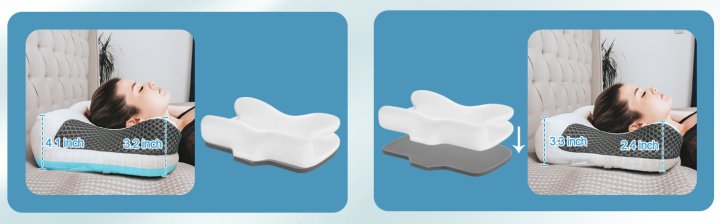
Do not average the high and low edges into a third “C2 height,” and do not add the listed base thickness to create your own comparison point when the FAQ already publishes both edge configurations. We sell the Elviros C2. If C2 is the model you are checking, use our C2 dimensions and buying-check section for the numbers, then review the official Elviros C2 product page.
Three side-by-side pillow loft decisions
Each decision below answers a different buying question. The people and numbers are hypothetical reader examples, not brand measurements and not test results. If a situation seems to fit more than one decision, apply the stricter one: Keep separate beats Ask, and Ask beats Match.
Decision 1: “Is this candidate the same height as the pillow I already own?”
A reader’s current pillow measures 4.0 inches at the center of the sleeping surface, logo side up, cover on, no removable base fitted, unloaded. A candidate listing states 4.0 inches of pillow loft, measured at the center, logo side up, cover on, no removable base fitted, and unloaded. Point, orientation, cover, insert/base state, and load condition all match, so the decision is Match on paper: both numbers describe the same kind of listed height.
Treat that Match as far as it goes. Matched reporting conditions do not establish identical comfort, identical feel, or interchangeability. Two pillows can publish the same pillow loft and sleep completely differently, because fill, firmness, and cover fabric sit outside the number. The Match tells you the heights are comparable as written; it says nothing about which pillow you will prefer.
Decision 2: “The listing gives one number and no measuring point — can I compare it?”
A candidate listing states 5 inches of pillow loft. No measuring point, cover, insert, or load condition is stated. The reader sends the short seller question from this article. The reply comes back: “The pillow is 5 inches thick as listed.”
That reply restates the number without adding any missing condition, so the comparison stays Ask, and after a follow-up that still leaves slots unknown it moves to Keep separate. Do not read 5 inches as larger or smaller than a home reading; an unanchored number is not evidence of thickness in either direction.
Decision 3: “The candidate’s listed number is bigger — is it a thicker pillow?”
A reader measures their contoured pillow’s low edge at 3.0 inches, cover on, no base fitted, unloaded. A candidate lists 4.5 inches measured at the high edge with the base fitted. The candidate’s number is larger, but the two numbers describe different facts: a different edge and a different configuration.
Decision: Keep separate, because the edge and the base both differ, so the 1.5-inch numerical gap should be compared only after confirming the same point, orientation, cover, base and load.
Reading an incomplete seller reply
A reply can answer one slot and leave the rest open. “It was measured flat” does not by itself establish the load condition, and it says nothing about the point. “It is standard size” answers none of the four worksheet slots. When a reply arrives, split it into the four slots — measuring point, orientation, cover and insert/base state, load condition — and mark each slot answered or still missing.
A complete reply sounds like: “The listed height is the highest point, logo side up, measured with the cover on, removable base not fitted, and no weight on the pillow.” That fills every slot and the comparison can proceed. A first incomplete reply stays Ask; if follow-up still leaves the missing slots unknown, the listing’s pillow loft becomes Keep separate rather than guessed.
A follow-up works best when it names one missing slot: “Thanks — is the 5 inches the center or the highest point?” Ask one specific question per message, and do not repeat slots the reply already answered.
Exact versus approximate pillow loft numbers
Some sources publish exact-looking values; others publish approximate ones. When a source writes “about 4 inches,” as the TEMPUR-Neck figures in the audit table do, treat the value as rounded rather than as a promise that the pillow loft is 4.00 inches.
If either precision or tolerance is unstated, a gap may be rounding, measurement setup, or a genuine difference. Write down which number was approximate and preserve both readings on the worksheet; if the gap matters, ask before deciding Match or Keep separate.
Compare pillow loft across units without adding precision
Pillow loft can be listed in inches or centimeters, and the unit changes the number without changing the pillow. Use 2.54 centimeters per inch, as given by NIST, and avoid retaining unsupported decimal places; keep only the precision the source stated.
A clearly hypothetical example is 4.0 in x 2.54 = 10.16 cm; display that as about 10.2 cm, while still retaining the original 4.0 in as the stated measurement. Do not turn 10.16 into a new spec, and do not imply a tighter tolerance than the listing supports. If a retailer gives both units, treat them as one stated measurement with a unit label, not as two independent measurements.
If a value is only a hypothetical unlabeled “5”, it cannot be used until the unit is known: 5 in and 5 cm are different heights, and a carton label cannot stand in for pillow height because it describes packaging, not the filled edge being compared.
The same discipline applies to pillow loft when one number is high-edge with base removed and another is low-edge with base fitted. Conversion only changes units; it does not resolve mismatched point or load. Round only the converted display, not the source value, and never average two figures captured under different conditions. If the measurement point differs, or if one reading was taken under weight and the other without, convert units first, record the conditions beside each figure, and keep the comparison separate until the same point and same load are known.
Document the retailer spec before you order
Before ordering, copy the listing’s stated pillow loft, measuring point, configuration, cover and insert state, and load condition into the worksheet exactly as written, with the date and the exact variant or size you selected. Keep a screenshot or the pasted text. Retailer pages get revised, and “exactly as written” is your reference if the page later says something different. When the seller answers a question, paste that answer into the worksheet too, dated, so the reply and the listing travel together.
When the box arrives, check what came before assuming a mismatch. Confirm the variant and size on the label against your worksheet. Set the cover, base, and orientation to the states you wrote down, then take one or two readings at the listed point with the home method. Compare numbers only after those checks.
A “wrong loft” result can come from a setup difference: a base left fitted or removed, a contoured pillow flipped so the wrong edge faces up, or a cover added after the listing’s measurement. Recheck the point, orientation, cover and insert/base state, and load; if the readings still differ, preserve both and ask the seller. The dated worksheet is a personal record, not warranty proof.
A completed worksheet: one fictional reader, start to decision
The question this scenario answers: “Should I order this replacement?” The reader and the listing are fictional and are not tied to any product mentioned in this article.
A reader owns a generic contoured pillow with a removable base, and the replacement pillow has one too. The replacement listing states all four worksheet conditions plainly. The reader measures the old pillow with the home method, records both readings instead of averaging them, and copies the listing exactly.
Home measurement worksheet
Current pillow:
Measured point: contoured high edge
Configuration: cover on; removable base not fitted; logo side up
Reading 1: 3.9 inches
Reading 2: 4.0 inches
Published candidate listing:
Published pillow loft: 4.0 inches (stated approximate)
Published measuring point: high edge
Published configuration: cover on; removable base not fitted; logo side up
Load/cover condition stated? yes — “measured flat, unloaded”
Decision: Match (approximate)
Seller question sent: none needed; all four slots stated
The candidate’s 4.0 is approximate, so the reader preserves the 3.9 and 4.0 readings and does not call the gap rounding, measurement setup, or a defect. The worksheet still gives a reporting Match on paper for the setup: same point, orientation, cover, removable-base state, and load. The reader orders knowing the setup matches on paper; whether the loft is identical or sleeps the same is a separate question.
When the replacement arrives, the reader repeats the same configuration before judging anything: cover on, no base, logo side up, high edge. The reader records the 4.0-inch result and keeps it as the next baseline before judging anything else.
Copyable comparison worksheet
Home measurement worksheet
Current pillow:
Measured point: ordinary center/edge OR contoured high edge/low edge
Configuration: cover on/off; insert/base state; orientation
Reading 1: write the number and label it with the unit, such as inches or cm
Reading 2: write the number and label it with the unit, such as inches or cm
Published candidate listing:
Published pillow loft: write the stated number and label it with the unit, such as inches or cm
Published measuring point:
Published configuration:
Load/cover condition stated? yes/no/unclear
Decision: Match / Ask / Keep separate
Seller question sent:
Short seller question: “Which point does the listed pillow loft measure, and was it measured with the cover and any removable base installed, without external weight?”
Leave a Reply