The short answer: whichever closure the maker confirms fits your exact insert — and if your pillow is the Elviros S1, that is the official zippered replacement cover linked below. The zipper vs envelope pillowcase choice sounds like a style preference, but closure type alone does not prove fit on a contoured, cervical, or shoulder-cutout insert. A zipper gives you a mechanical closure you operate with a slider; an envelope gives you an overlapping fabric flap with no hardware. Neither tells you whether the opening lines up with your pillow’s shape, so run the three checks below before you order.
Table of Contents
Zipper vs envelope pillowcase: how each closure works
Brands word the choice differently. Blissy describes an envelope pillow case with a back opening, MATTEO contrasts envelope- and zipper-closure pillowcases and refers to an end flap, and Mulberry Park frames it as overlap versus zipper. Use these sources for wording and design intent, not as proof that any flap or zipper variant fits your insert.
| Closure | How you use it |
|---|---|
| Envelope overlap | One fabric flap overlaps the opening; no slider or tape; tuck the insert behind the flap |
| Zipper | A slider and tape close the opening mechanically; run the slider to open or shut |
Where the opening sits is separate from how it closes
Closure mechanism and opening location are two different features. The mechanism is how the cover fastens shut — a flap overlapping the slot or a slider traveling along a tape. The location is where the cover lets the insert in and out. Changing one does not change the other, so the word “zippered” or “envelope” never tells you, by itself, where the slot sits.
To find the opening on a cover you own, turn the cover inside out and lay it flat. Locate the insertion slot and note which panel or edge it sits on. Then run your fingers along the seam: a zipper tape feels like a narrow ridged strip with a metal or molded stop, while an envelope shows a second layer of fabric folded over the slot. Measure the usable opening length — the gap you can actually pass foam through — and compare it with the widest point of your insert.
The linked sources document specific examples: Blissy a back opening, MATTEO an end flap. They do not catalog every placement, and your cover may put its slot somewhere else, which is exactly why the physical check comes before any shopping.

Diagnose your fit problem
Symptom A: the insert protrudes from the opening. Foam or fill shows while the cover is closed. Treat this as an observation of protrusion only; it is not by itself a finding of mismatch, and no general cause is implied.
Symptom B: the cover has shifted on the foam. The cover still encloses the insert, but its seam or shaped cutout no longer lines up with the contour. Displacement alone cannot identify seating or dimensions; if instructions are available, follow them, and avoid forcing the cover into place.
A worked example, clearly hypothetical
Picture a hypothetical case: you own a contoured cervical insert with a shoulder cutout, and a replacement cover arrives that closes fully without forcing — no protrusion — yet the cutout panel sits visibly lower than the foam’s contour. Work through it in order.
Start with practical observation. Turn both covers inside out, lay them flat, and look. Does the new slot sit in the same place as the old one? Is the usable opening the same length? Does the cover’s contour panel actually match the foam’s contour, or only roughly? Note what you see before deciding what it means.
Next, ask what the maker specifies. Does the maker state an insertion orientation — which end or edge goes in first — and a clearance allowance, meaning how much ease the cover is cut with around the insert? Check the listing’s specifications, or ask the seller before you buy. When the maker is silent, that gap is missing information, not evidence for one cause over another.
Last, list the possible causes before picking one. A usable opening that is too short, a slot in the wrong place, internal dimensions that do not match your insert, a contour panel cut for a different model, foam that has compressed or expanded since purchase, or an insertion sequence that differs from the maker’s intent can each produce the same visible misalignment. Match your observations to the most likely cause; if the evidence points to dimensions, ask the seller for the figures in the question below. The example is invented, but the sequence — observe, check the maker’s stated specifications, then weigh causes — applies to any shaped-pillow fit problem.
What missing information does to your decision
If any part of the seller’s answer is missing — or the listing is cross-model or unverified — request the maker’s stated internal dimensions and the opening’s usable length and location before you pay; fit stays unconfirmed, and your realistic options narrow to waiting for a complete answer or choosing a different listing. The exception: an exact official maker compatibility or size match for your specific pillow is useful evidence on its own, even when opening dimensions aren’t stated.
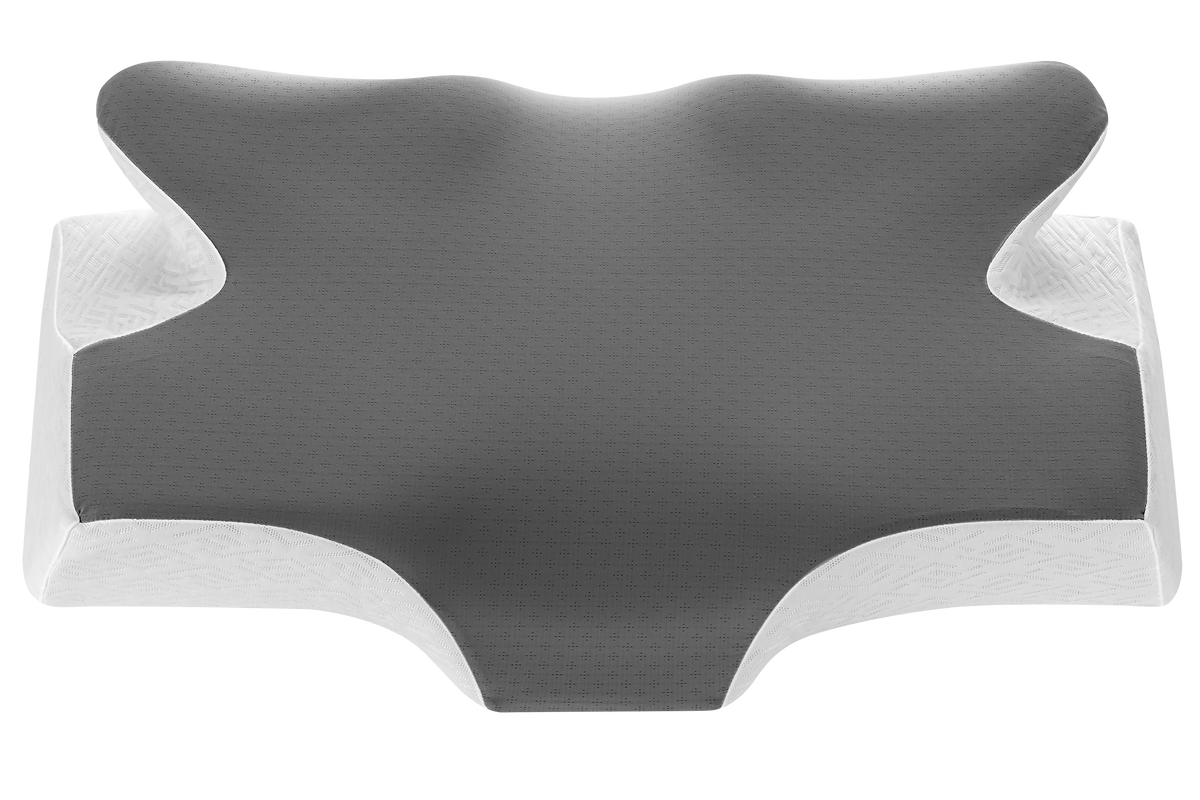
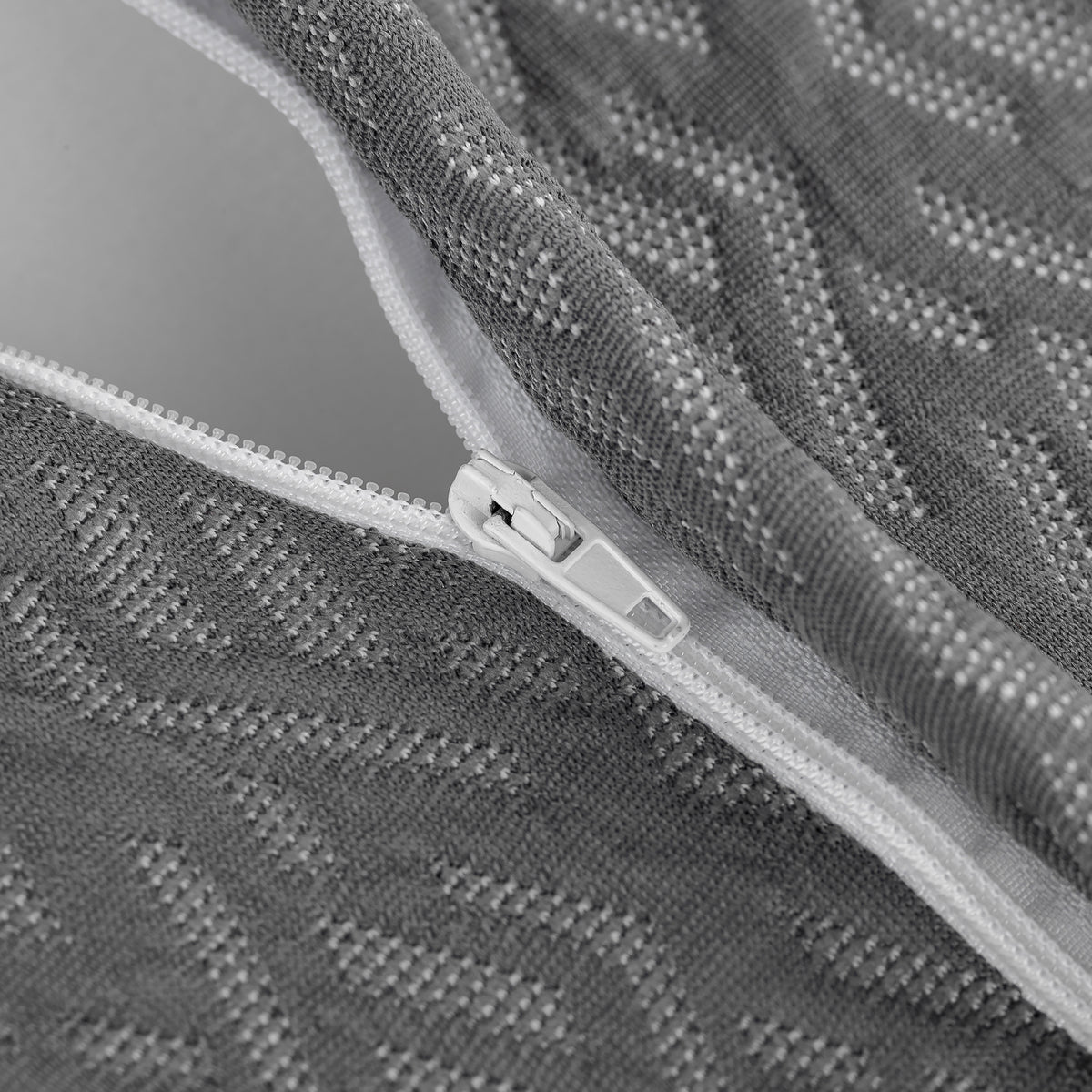
A closeup photo can show hardware: exactly one zipper closeup documents the hardware, and two wider images show the cover shape or foam profile; no envelope photo is included, and visual evidence alone does not establish fit.
Annotated fit worksheet
Scope: This worksheet compares two invented products — the short-end example (zipper opening on one short end) and the long-edge example (envelope opening along one long edge). Both examples are hypothetical; the gallery shows only the Elviros S1 zippered cover.
In-hand observations (you can verify these yourself)
- Which physical edge opens. Lay the cover flat and identify the opening’s edge relative to the cover’s longest dimension, taper, or contour. The short-end example loads from a short end; the long-edge example loads from a long side. These are different access orientations and are not interchangeable.
- Opening span vs. its edge. Measure the usable opening length in hand; compare it with the full seam and the insert’s widest point. Approximate measurements taken of a cover in hand are distinct from maker tolerances or verified compatibility; they remain rough only and do not confirm internal dimensions or fit.
- Opening orientation vs. pillow asymmetry. Note whether the opening is on the same side as your pillow’s taper, offset, or contour. An end opening and a side opening route insertion along different axes of the same pillow.
- Closure behavior in hand. Run the short-end example zipper: does the pull travel the full seam or stop short at a barrier tab? Tuck the long-edge example flap: does it seat flat or gape at the corners? These are workmanship signals, not fit proof.
- Listing-photo consistency (hypothetical long-edge example; not the pictured S1 cover). The long-edge example listing shows openings on opposite edges in two photos, and the variant dropdown reads only “Standard.” Flag this ambiguity: the photo and the shipped cover may not match.
Seller should confirm (cannot be judged in hand)
- Exact OEM compatibility. Ask whether the cover is confirmed for your specific pillow model, not just your pillow’s general category. A stated OEM model match is the strongest single evidence available.
- Entry side for your variant. For the long-edge example, ask which edge the opening is on for the exact variant you would receive, in writing.
- Panel layout. Ask for a labeled diagram showing which edges are seamed, which open, and where any internal panels or gussets sit relative to the opening.
Three checks before buying
- Edge match: Does the cover’s opening edge correspond to an edge your pillow can plausibly be inserted from, given its asymmetry?
- Span sufficiency: Measure or estimate the usable opening length against the insert’s widest point. Never force a resisting zipper or flap.
- OEM confirmation: Does the seller confirm compatibility with your exact model in writing, and does the listing resolve variant ambiguity?
Limit: No worksheet, including this one, proves fit. Treat OEM compatibility as useful evidence, and treat everything else as a reason to ask the seller a specific question.
Ask before you order
Send the seller this one question — it is the entire fit checklist:
Which exact model and variant does this cover fit, what finished internal dimensions does the maker state, and what are the usable opening length and opening location?
Two handling notes belong with that checklist. First, non-forcing: on the first fit check, close the cover normally; if a zipper resists, stop rather than forcing the slider or pulling at the seam, and an envelope flap should close over the insert without wrestling the foam into place. Second, cover-only: confirm before ordering whether the listing is cover-only or includes a pillow, since the two can look similar in photos.
Check the selected variant before paying
For an owned contoured sleeping pillow, choose a zipper or envelope pillowcase by matching the case to the pillow’s shape and the seller’s listed variant, not by closure style alone. Trace the pillow’s silhouette and keep that record for a seller question; a drawing or written seller spec helps compare and does not guarantee fit. When the selector, cart, and order confirmation display the actual model/variant details, verify them at each step; a cart check cannot catch every mismatch.
If the cart omits those details, do not infer them from the title or image; contact the seller before ordering, send the traced silhouette or written spec, and ask for a written confirmation you can keep with the order.
Which cover to order
If you want the mechanical closure, choose the zippered cover; if you want the flap with no hardware, choose the envelope cover — and order only after the listing confirms fit for your exact pillow as checked above and the selected option is available.
Disclosure: Elviros sells this item, and Elviros also publishes this journal. If you have confirmed your pillow is the Elviros S1, use Elviros’s official replacement cover for the S1 page; this guide to identifying the Elviros S1 pillow is only for the model check. On that cover page, confirm the original S1 size and the matching option before treating any shared 26 or 28 prefix as relevant.
Keep the checks separate: “compatible with S1,” “cover only,” and “zippered” verify model and closure; the option beginning 26 or 28 is only a variant cross-check against your original S1 order size, not proof of fit or availability. If the matching option is unavailable or the mapping is unclear, do not order from that state—contact the seller or recheck the official page.
Leave a Reply