Before you order a shoulder cutout pillow, measure three things on a pillow you already use: overall length and width, shoulder recess width, depth, and orientation, and the higher and lower edges. Then compare those numbers with the exact product being sold.
Table of Contents
This article covers the Elviros S1 as sold by Elviros. The official S1 page lists Queen at 26 × 16.5 in and King at 28 × 16.5 in; both listed widths are 16.5 in, and the listed Queen length is 2 in shorter than King. Treat Queen and King as S1 shoulder cutout pillow variant names, not pillowcase-size labels.
Check 1: overall length and width
Use your current pillow as the measuring baseline. Lay it flat, smooth out obvious wrinkles, and measure end to end at the longest point and side to side at the widest point. Record both numbers in inches. Compare them with the S1 column in the worksheet instead of guessing from the variant name.
Check 2: Shoulder recess fit for a shoulder cutout pillow
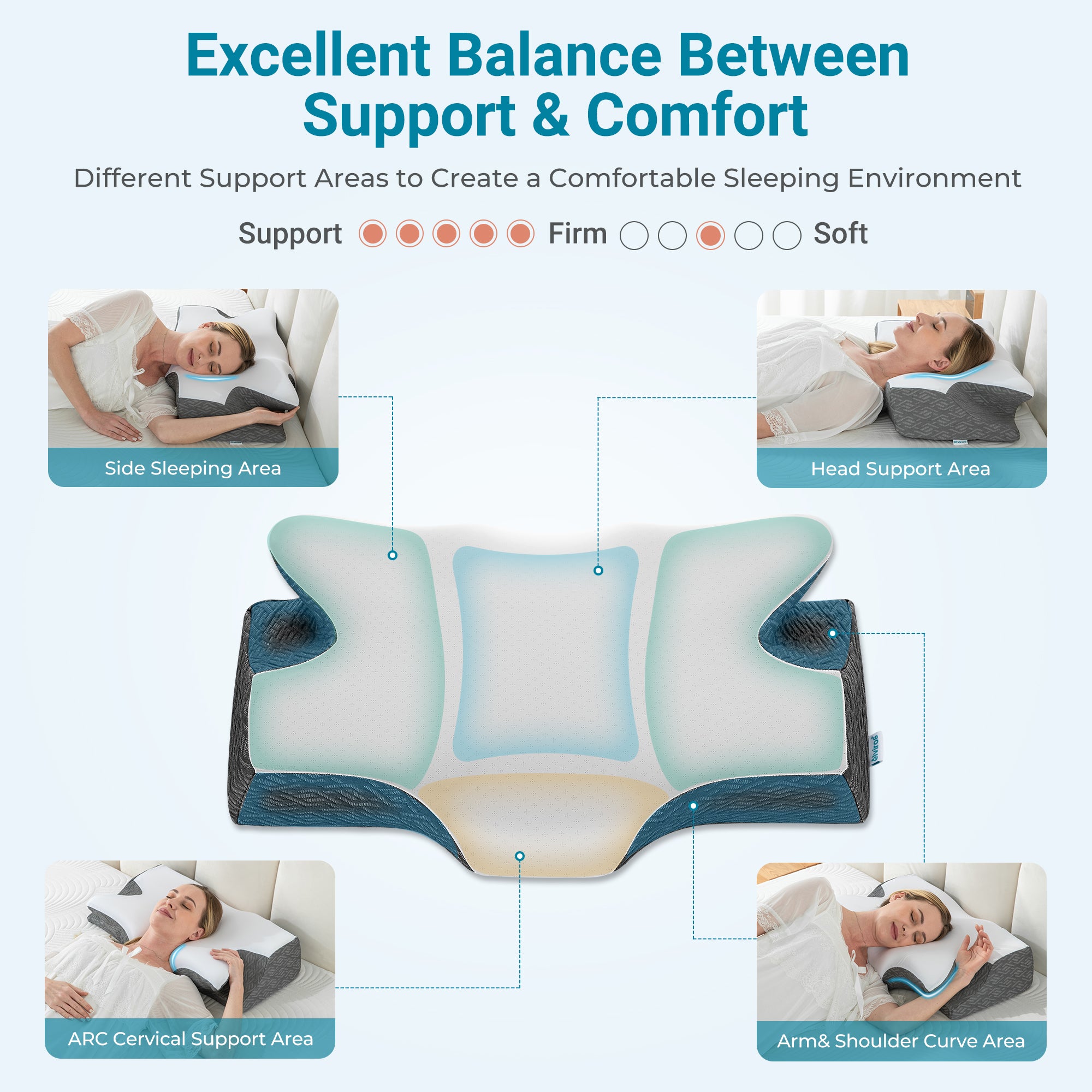
The official S1 shoulder cutout pillow gallery image marks the shoulder and arm area. The listed S1 overall dimensions do not specify the recess width, the recess depth, or which way to position the recess. Ask Elviros to confirm all three before you order.
Place a straightedge across the mouth of the recess and measure the gap between the two points where the straightedge meets the pillow, not the length of the straightedge itself. Then measure at right angles from that line to the deepest point for depth. If there is no recess, leave these cells blank. Note which way the recess faces relative to the sleeper.
Check 3: high/low edge profile
Elviros describes two heights for the S1 shoulder cutout pillow, and I could not verify a number for either edge from the product listing. To measure your current pillow, lay it unloaded on a flat surface and measure the two long edges vertically from the flat surface at their midpoints without compressing the pillow. Record which edge is higher and which is lower.
What to ask Elviros before purchasing
- What are the S1 Queen and S1 King shoulder recess width and depth?
- Is the recess on one side only, or is it reversible?
- What are the higher-edge and lower-edge heights for each S1 size?
- Do the listed Queen and King figures match the exact current variant?
- What pillowcase dimensions do you recommend for the S1 Queen or S1 King?
Comparison worksheet
Copy this table and fill it in before ordering a shoulder cutout pillow.
| Check | Your current pillow | Other candidate, if any | Elviros S1 listed fact | Ask Elviros before ordering |
|---|---|---|---|---|
| Overall length | Queen 26 in; King 28 in | Confirm current variant dimensions | ||
| Overall width | 16.5 in listed for both sizes | Confirm width for exact variant | ||
| Shoulder recess width | Not listed | Request width by size | ||
| Shoulder recess depth | Not listed | Request depth by size | ||
| Recess orientation | Arc area shown in official gallery image | Left, right, reversible, or one orientation | ||
| Higher edge height | Not listed | Request exact height by size | ||
| Lower edge height | Not listed | Request exact height by size | ||
| Pillowcase fit | Case fit varies; ask for recommended case dimensions | Request recommended case dimensions |
S1 Variants on the Bed: Tape Rectangles for Queen and King
Lay two tape rectangles on the mattress before choosing a shoulder cutout pillow. Make one rectangle 26 inches long and 16.5 inches wide for the Queen. Make the other 28 inches long and 16.5 inches wide for the King. Because the width is equal at 16.5 inches, the only real difference you are testing is length. The King rectangle runs 2 inches longer than the Queen, so set the tapes side by side with a small space between them and look at the extra reach.
Measure the open lateral span in one straight pass. For one shoulder cutout pillow, run a tape measure across the bed at the height where the pillow would rest and read the clear width from edge to edge. For two pillows, read the clear width the same way and treat it as the budget you must fill. Keep the tape level and note the number in inches.
Measure front to back clearance as its own separate check. Start at the headboard or the wall line and run the tape toward the foot of the bed. Mark where the front edge of the tape rectangle lands and read how much open mattress remains beyond it. Keep this reading apart from the lateral span so the two numbers never blend. A long lateral fit still fails if the front edge crowds the bedding or hangs past the mattress.
For two pillows, add the parts before you buy. Write the intended length of the first pillow and the intended length of the second. Between them add the gap you want in the middle. The total is length plus length plus gap. Compare that total with the open lateral span you measured. If the total is larger than the span, the pair will not sit as planned on that bed, no matter how good each tape rectangle looks alone.
Use the headboard and bedding as a visual frame. Slide each tape rectangle against the headboard and see how much headboard remains above the top edge. Lay the flat sheet and duvet in place and watch where they fold over the tape. This shows overlap and drape in a way a spec line cannot.
A tape footprint for a shoulder cutout pillow is honest about outer size only. It cannot tell you the recess depth, the shoulder channel width, or the exact edge figures around the cutout, and those are unverified until the maker provides drawings. Treat the rectangle as a ruler for space. Let verified specs handle contour, and let the bed decide whether Queen or King belongs.
Read the S1 recess as geometry, not as a promise
The official S1 photo marks the shoulder and arm curve, yet it does not verify width, depth, orientation, or edge heights. Treat that image as a silhouette of a shoulder cutout pillow: it can show where a feature sits on the outline, but it cannot show which edge meets the headboard, which side is left when lying on the back, or whether the arm channel exits to one side, both sides, or the end.
A silhouette answers shape questions. Orientation answers placement questions. Keep the tasks separate for this shoulder cutout pillow. First describe the contour you see. Then anchor it to the sleeper with labels such as headboard end, foot end, left side, right side, top surface, side seam, and arm outlet. If those labels are missing, the honest status is UNKNOWN, not small, large, left, or right.
Do not scale the photo. Perspective can make a curved recess look wider from one angle and shallower from another, and a shadow can imitate an edge. When a shoulder cutout pillow listing shows only the outer case and a marked curve, use the picture to name the feature and use your sketch to request endpoints. That keeps the inquiry about geometry rather than about feel.
Share one sketch for a shoulder cutout pillow with a fixed orientation reference. Draw the sleeping surface from above. Mark the end nearer the headboard, label the left side for a person lying on the back, and mark the side seam or piping if visible. Add a second arrow where the arm curve leaves the outline. These references let the seller answer against your page instead of a marketing photo.
Put measurement endpoints on the sketch as letter pairs, then list the pairs without inventing values. For a shoulder cutout pillow inquiry, use A to B across the narrowest recess, C to D from the nearest side edge to the deepest point, E to F from the recess rim to the arm outlet, and G to H along the outer edge near the outlet. Leave every pair blank until the seller confirms it.
Subject: S1 geometry only
Hello,
Please confirm Elviros S1 geometry only. Which end is the headboard end, and which side is left for a person lying on the back? What is the width across the narrowest shoulder recess? What is the depth from the nearest side edge to the deepest point? Does the arm curve open left, right, both sides, or the end? What are the edge heights at the recess rim and arm outlet? Use the letter pairs on the attached sketch. If an item is not measured, write UNKNOWN.
Thank you.
For a shoulder cutout pillow answer, paste each confirmed value beside the same letter pair and keep the units with the number. If one answer conflicts with the sketch orientation, ask which reference the seller used before changing the page. If the seller sends only another image, request endpoints once more and keep the table cell blank. A blank cell shows that width, depth, orientation, or edge height was requested and not verified.
Included cover or separate S1 case
Start by separating the part you can remove from the part that gives support. The seller describes the Elviros S1 shoulder cutout pillow as having a removable machine-washable cover in an 85% nylon / 15% spandex blend. Treat that as seller information, not your wash plan, and follow the care tag on the actual cover.

Open the box and lay the cover flat on a clean table. Check that the printed side faces outward and the inner fabric faces the insert. Follow the zipper or wrap edge around all four sides. Look for loose threads, skipped stitches, torn binding, or a missing pull. Confirm the opening line matches the insert shape and corners sit square.
Do not assume the foam or insert can be washed because the cover can be removed. The seller only confirms the cover material and removability in the product description. If the tag says different care steps, the tag wins. If the tag is missing, contact the seller and keep the insert dry unless the manufacturer clearly says otherwise.
A separate case is worth considering when the included cover is damaged, stained beyond what you want on the bed, or too loose after repeated washing. It can also help if you rotate two covers during laundry. That is different from promising better cooling, cleaner certification, or a longer pillow life.
If you shop for a replacement style cover, ask by exact model and size rather than by the shoulder cutout pillow nickname alone. Say Elviros S1 and give the length, width, and height you measure. Ask whether the listing is for the cover only or for a cover plus insert. A wrong module can look close and still fail at the closure.
Before buying a replacement cover for your shoulder cutout pillow, compare the closure type, seam placement, and opening direction with the included cover. Look at product photos for zipper pulls, flap covers, edge piping if present, and whether the printed label sits near the same end. A broader reference for comparing pillow specs generally is the seven-spec pillow buying guide.
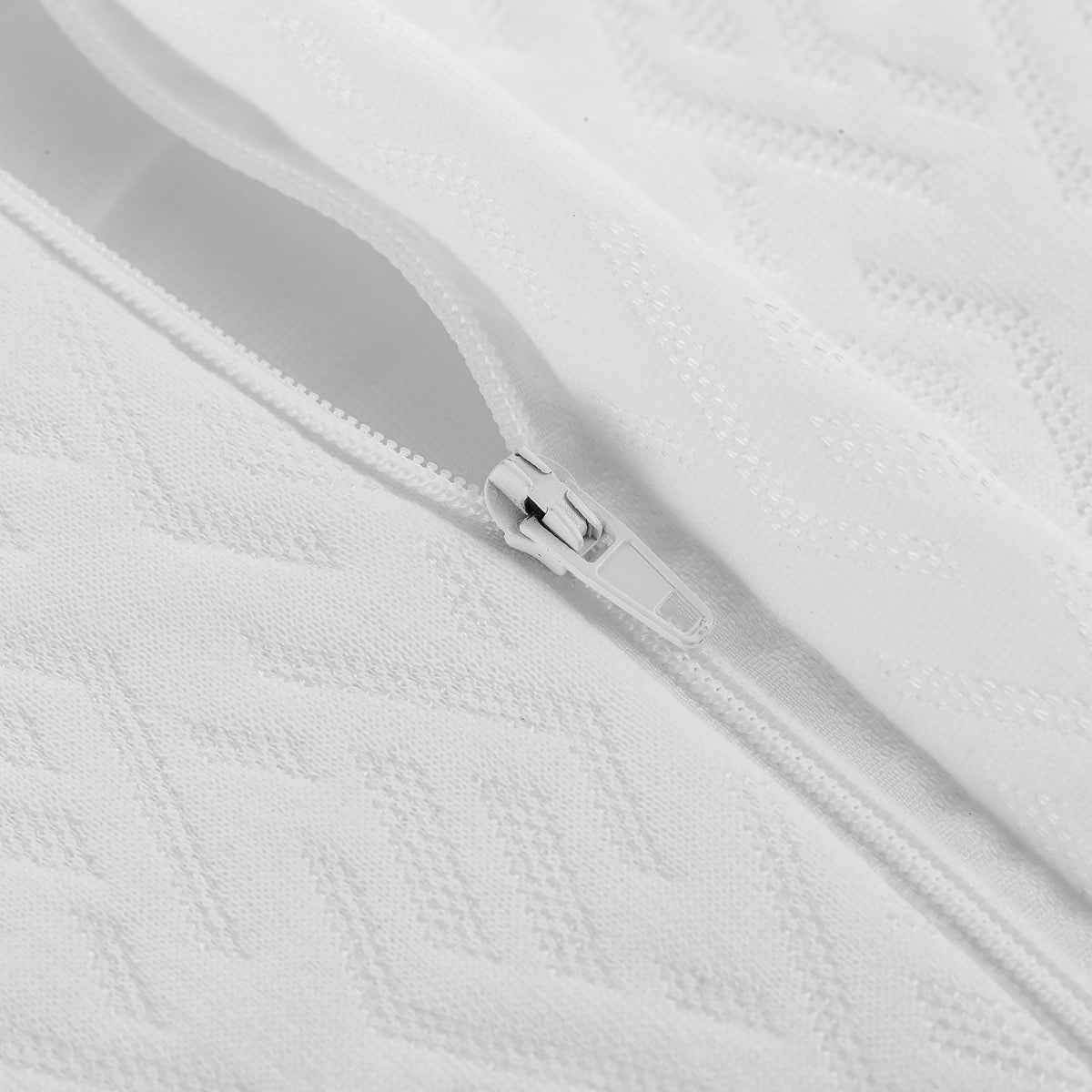
Keep measurements separate so you do not mix cover dimensions with insert dimensions for a shoulder cutout pillow. Measure the insert across its fullest length and width, then measure height with the shoulder cutout pillow resting naturally. Measure the cover flat only if the seller asks for fabric dimensions. Write each number with the part name and units beside it.
A care tag reading 85% nylon and 15% spandex can match the official S1 removable machine washable cover. That tag is not proof of insert care. Use the label, invoice, packing slip, warranty page, or seller record to separate cover from insert. Match SKU, lot code, model name, size, and replacement part number before ordering.
Please confirm this listing is for the cover only, not the insert. State the exact S1 model, production version, and size that the cover fits. Send the replacement part number and fabric content shown on the current tag. If cover only stock is unavailable, say so. Do not substitute a nearby size or different model. Give written confirmation before payment.
Match the exact S1 variant before you rely on it
Treat receiving as a matching task, not a formality. Before opening the box, write down the exact model name, size, and color you selected, plus the product URL from the order or cart. Save the option wording as shown by the seller, because a shoulder cutout pillow can share a family name while the size label carries the real difference.
Queen and King may show the same stated width in this listing, so width alone cannot confirm what arrived. Match the ordered size word on the invoice, outer carton if marked, product label, and any insert that names the variant. If the seller provides confirmation steps, compare each step with the label and write the result beside it.
Keep packaging as applicable until the variant is verified and any question is resolved. Retain the carton, sleeves, tags, insert, and accessories in received condition when they help identify the item or follow the seller's current process. For a shoulder cutout pillow, the label can be small, so photograph it beside the order page rather than relying on memory.
Use a simple source order. Trust a written answer only after you record it, then check whether the order page, label, and seller instruction still agree. Do not treat a chat reply, another buyer's photo, or a marketplace badge as proof unless it names the same model, size word, color, and product URL you saved.
If the label differs from the ordered variant, stop using the item for fit decisions and mark the answer unverified. Recheck the product URL for a changed option, the order confirmation for a substituted word, and the seller instruction for a separate step. A shoulder cutout pillow with a different size label should not be matched by feel, because the usable length is the point to confirm.
If a needed measurement for a shoulder cutout pillow is unavailable, do not infer it from width or from the name Queen or King. Ask the seller for the missing value in writing and request that the answer reference the exact model, size word, color, and product URL. Record the date, wording, and location. If the seller cannot provide it, treat the variant as unconfirmed even when the box looks correct.
Apply go, ask, or hold to every claim. Go only when the saved URL, selected options, label, and written seller answer all match. Ask when one source is missing or wording could mean more than one variant. Hold when the label differs, the needed value is not provided, or two reliable sources disagree. This rubric keeps a shoulder cutout pillow order verifiable and is not a promise that any listing is correct.
Once verified, keep the record with the order until normal use begins and no fit question remains. If anything later looks inconsistent, reopen the checklist instead of guessing. The goal is a traceable match between what was selected, what arrived, and what the seller confirmed in writing.
Buying decision path
Bring your filled worksheet to Elviros before buying a shoulder cutout pillow. The only S1 numbers are the listed length and the listed width, so ask Elviros for the recess width, recess depth, recess orientation, and both edge heights when a missing detail affects your choice.
Disclosure: Elviros sells the S1, and this article focuses on that product. For current variant details, see the Elviros S1 product page.
 English
Leave a Reply