When shopping for a CPAP pillow, product descriptions can use terms like memory foam, fiberfill, or quilted covers interchangeably or without explaining how parts fit together. Checking CPAP pillow materials means reading whether a material name applies to the inner fill, surface padding, or outer cover before making a purchase.
Table of Contents
Working Categories for CPAP Pillow Materials
Rather than assuming every pillow follows a uniform design, buyers can separate product descriptions into three informal working categories:
- Primary fill: The main interior cushion or core material identified by the seller.
- Surface padding: Secondary cushioning or quilted fiber placed over or around the core, if specified.
- Cover fabric: The fabric layer that encloses the interior parts.
Treating these as reading categories helps clarify what you are buying, because sellers do not always format descriptions the same way.
Two Documented Product Examples
When evaluating a CPAP pillow, examine the exact product SKU, the shell, any separate outer slipcase, and the core filling rather than relying on broad marketing categories. Product listings frequently group separate textile layers under mixed care instructions or list accessories under similar names.
For example, the Core Products CPAP Pillow (SKU FIB-280-WH) lists a 100% polyester fiber filling, a shell made of a cotton/polyester blend, and an included fitted pillowcase made of a cotton/spandex blend. Core specifies cold hand washing under general care, while its FAQ states that the removable cover can be machine washed. Because the listing does not clarify whether the hand-wash instruction applies to the shell, the fiber filling, or the entire assembly, buyers should confirm the cleaning method for each part directly.
Contour Living illustrates how outer slipcases and replacement covers differ across distinct catalog entries for the same pillow line:
- Main pillow: The Contour CPAPMax Pillow lists a zippered cover quilted with mesh and fiberfill, alongside an optional cotton case.
- Separate slipcase: The Contour CPAPMax Pillowcase is a separately sold cotton slip-on cover with a button closure. Contour notes that removing this exterior case avoids opening the zippered original cover or exposing internal inserts.
- Replacement cover: The Contour CPAPMax Replacement Cover is cataloged as a distinct item whose URL slug refers to original or cool models, but its visible description does not give a variant-by-variant fit list; buyers should verify their exact pillow model before purchasing.
Before purchasing replacement layers or accessories, verify the exact model designation and ask the seller: “Can you provide the part-specific material breakdown and care label for the inner filling, shell, and outer cover for this exact SKU?”
Density Versus Firmness
When reading foam specifications, density and firmness represent two independent physical measurements. According to industry guidance from the Polyurethane Foam Association (PFA)—which evaluates standardized flexible polyurethane foam specimens rather than completed pillow assemblies—density does not determine how soft or firm a foam feels.
- Density: Density is defined as mass divided by volume, typically reported in pounds per cubic foot (pcf) or kilograms per cubic meter (kg/m³).
- Firmness (Indentation Force Deflection / IFD): IFD measures the force needed to indent a foam sample by a specified fraction of its original thickness. The PFA describes standard testing at a 25% indentation.
These standardized metrics characterize raw foam specimens and cannot be directly extrapolated to predict the overall feel of a finished, multi-layer pillow. If a seller uses descriptive terms like “extra firm” or “adaptive support” without publishing verified IFD or density figures, the underlying physical measurements remain unknown.
Dropping a steel ball onto a foam sample measures rebound bounce rather than recovery speed, so resilience percentages do not indicate how quickly foam returns to its original shape.
Comparing Density and Firmness Metrics Across Foam Layers
A spec sheet might list a foam layer at 3.0 lb/ft³, while another brand lists 48 kg/m³. Because one pound per cubic foot equals approximately 16.02 kilograms per cubic meter, 3.0 multiplied by 16.02 yields roughly 48 kg/m³. On paper, these two foam density figures represent approximately the same mass per volume. However, that numerical equivalence does not mean the materials share identical polymer formulation, internal structure, or filler content.
These figures cannot be compared directly if one manufacturer reports raw polymer density while another includes mineral fillers or chemical additives. According to the Polyurethane Foam Association (PFA) foam-performance page, polymer density excludes fillers, whereas total density includes them. Furthermore, if one specification describes a core support base and the other measures a top contour insert, the numbers describe entirely different layers in a multi-tier CPAP pillow assembly.
Firmness ratings introduce an additional point of divergence. Indentation Force Deflection (IFD) measures the force required to indent a foam sample, but comparing IFD values requires identical measurement units, test fixtures, and indentation depth percentages. For instance, a 25% IFD rating cannot be compared against a 65% IFD rating to determine which foam is firmer. The 65% test indents significantly deeper into the material, naturally requiring higher force on the exact same foam block.
Because testing protocols vary, results across disparate fatigue evaluations cannot be evaluated against one another without identical cycle parameters.
Evaluating Spec Sheets and Incomplete Listings
- Ask about active layers: When contacting a manufacturer, ask the seller about only the layer you will actually use rather than inquiring about the entire assembled unit.
- Treat mismatched sheets as unknown: If two spec sheets do not share matching measurement units, test setups, or indentation percentages, mark their comparison unknown instead of presuming equivalence.
- Note on subjective adjectives: If a listing provides only subjective descriptors like “extra supportive” or “soft-touch” without numerical metrics, treat the wording as an unverified label and request numerical IFD or density specs for that specific layer before purchasing.
In "Foam Testing" (presented by Todd Bates of Huntsman, uploaded by Wayne Bowman, and featured on the PFA page at PFA Foam Performance via YouTube original), the 1:26–3:07 segment explains two foam sample measurements: density and indentation force deflection. The explanation addresses standardized foam specimen testing rather than live laboratory footage or testing of a finished CPAP pillow.
7 Buyer Questions to Check
Match these seven factual questions directly against the retailer listing for your exact selected SKU:
- Does the product listing identify whether a named material is located in the inner core or in the outer cover?
- Does the listing specify if the internal cushioning consists of memory foam, fiberfill, or a combination of distinct layers?
- If multiple materials are listed, does the manufacturer state whether individual sections can be adjusted or removed?
- Does the listing state numerical density figures, or does it only describe subjective firmness levels?
- Does the product page provide specific manufacturer cleaning instructions for each individual layer?
- How does the description explain the relationship between the cover fabric and any sewn-in padding?
- What return terms or trial policies does the retailer provide if the physical cushion does not meet your personal preferences?
CPAP Pillow Materials Comparison Table
Use the two columns below to compare CPAP pillow materials and verified specifications side by side, marking unconfirmed claims as unverified:
| Field | Option A | Option B |
|---|---|---|
| Core Material Listed | ||
| Cover Material Listed | ||
| Removable Layers Documented | ||
| Density Stated by Maker | ||
| Manufacturer Cleaning Guidelines |
Buyer Worksheet: Real-World Layer and Case Verification
When a buyer already owns a pillowcase and prioritizes replacing only an individual layer later, reviewing published specifications helps identify modularity. Below are three filled reference examples illustrating how to record verifiable specifications, formulate targeted seller questions, and determine next actions when evaluating CPAP pillow materials and enclosure designs.
Example 1: Core Products FIB-280-WH
The Core Products CPAP Pillow (FIB-280-WH) listing specifies a polyester fiberfill core, a 4-inch side-panel measurement, an included fitted case, and provides a direct catalog link to another white fitted case. The listing does not state whether standard aftermarket pillowcases fit the dimensions or how the fill is secured.
- Source: Core Products FIB-280-WH product page.
- Open Question: Does the outer case feature a removable opening to access or replace the polyester fiberfill, and what are the specific outer perimeter dimensions for third-party pillowcases?
- Next Action: Inquire with the seller regarding fiberfill replacement access and confirm whether replacement cases match your existing case dimensions.
Example 2: Contour CPAPMax Pillow
The Contour CPAPMax Pillow specification details a zippered mesh and fiberfill quilted cover, an optional cotton slip-on case featuring a button closure, and a separately cataloged replacement cover. Specific measurement points for thickness across the profile and compatibility with non-branded slipcovers are left unspecified by the manufacturer.
- Source: Contour Living CPAPMax product catalog.
- Open Question: At which exact location on the pillow perimeter is thickness measured, and are individual foam inserts available separately from the complete replacement cover?
- Next Action: Contact customer service to clarify layer availability and verify whether your existing case accommodates the button closure.
Example 3: Elviros C2 Contour Pillow
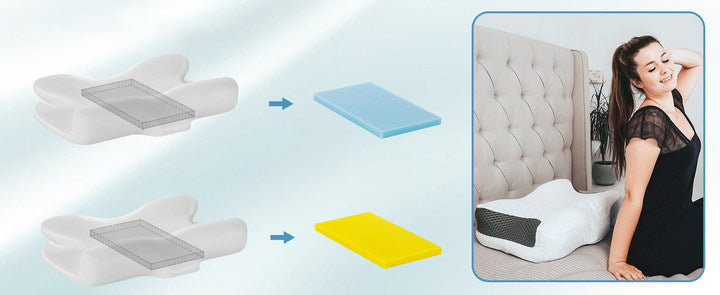
The official Elviros C2 listing describes two replaceable memory foam inserts and a detachable bottom height base for profile adjustments. However, the exact textile composition of the outer cover for the specific SKU and the availability of standalone replacement cases are unknown from the product listing.
- Source: Official Elviros C2 product listing.
- Spare Case Priority Branch: If your priority is spare case confirmation, ask the seller to confirm the exact outer case fabric composition and whether standalone replacement cases matching the SKU are sold separately.
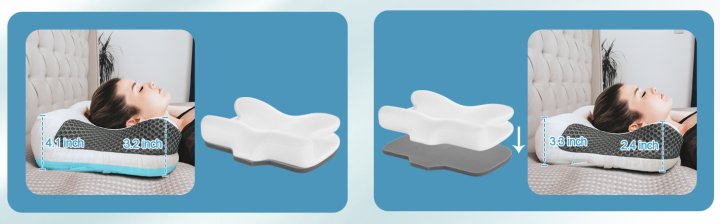
- Height Configuration Priority Branch: If your priority is comparing height configurations, ask the seller to provide height dimensions at corresponding measurement points with and without the detachable base installed.
- Next Action: Select your primary purchasing priority, submit the corresponding inquiry to the seller, and record verified dimensions prior to ordering.
Reading Label Examples
The following two examples are purely hypothetical illustrations to demonstrate how listing structures differ:
- Hypothetical Listing A: Names foam and fiberfill without separating parts. A buyer reading this description cannot tell from the text alone whether the materials are blended inside the pillow or divided into separate sections.
- Hypothetical Listing B: Labels fill and cover separately. A buyer reading this description can identify which material forms the internal cushion and which material forms the exterior cover.
Post-Arrival Inspection and Measurement Protocol
Physical inspection of delivered CPAP pillow materials requires following product-specific unpacking instructions and expansion timelines. For instance, the Core Products FIB-280-WH FAQ specifies that a compressed pillow may take 5 to 7 days to regain its shape after unpacking. Because recovery times vary by model, record unpacking timelines and inspect all components methodically before use.
Step-by-Step Arrival Checklist
- Verify return conditions prior to opening: Confirm the seller’s posted return dates and packaging condition requirements before unsealing. If the seller’s return window is shorter than the expected expansion wait time, ask the seller for guidance before opening.
- Log unpacking start time: Read model-specific unpacking inserts and document the exact arrival and unboxing date to track the expansion period accurately.
- Audit components and photograph labels: Compare delivered parts against the listing description. Take clear photographs of all sewn-in part labels, fabric tags, and batch markings, ensuring no personal information or shipping labels are captured.
- Measure dimensions on a flat surface: After the specified expansion window has elapsed, place the pillow unloaded on a rigid, flat surface. Use a ruler to measure height and width at consistent matching points corresponding to the manufacturer’s specification.
- Clarify unlisted measurement baselines: If no comparable measurement point is defined on the seller’s spec sheet, contact the seller with your photographed setup to verify measurement points before concluding dimensions deviate.
- Consult seller before washing or modifying: If parts are missing or care instructions are unclear, ask the seller for clarification before washing, modifying, or substituting any interior layers.
Verifying part labels and measuring dimensions under consistent, unloaded conditions ensures that any follow-up questions submitted to a seller are grounded in documented physical evidence.
Featured Product Information
We sell the Elviros product linked below.
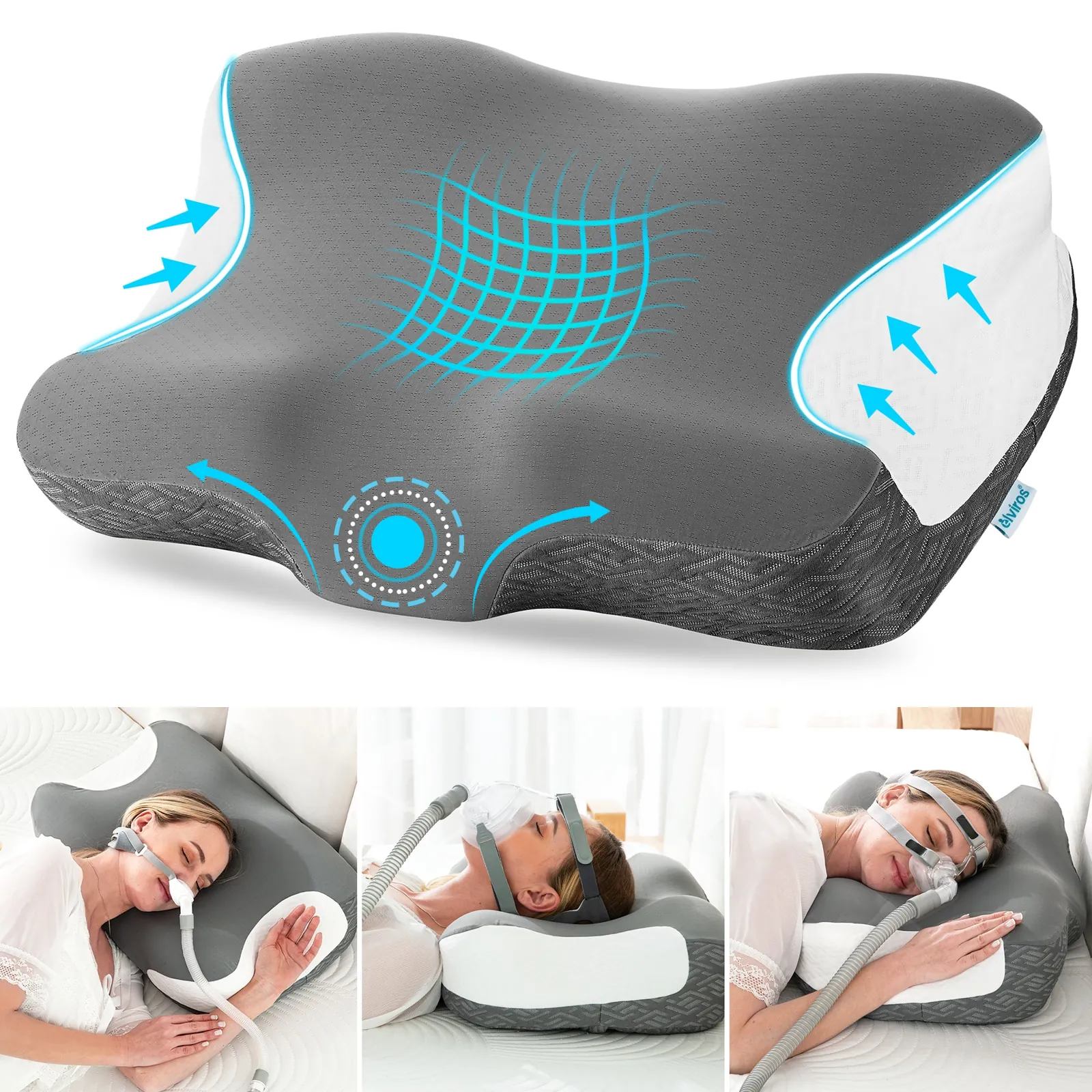
Retailer image only; not proof of internal material properties.
When evaluating the Elviros C2 listing, review each pillow layer and cover separately rather than treating the core as an undivided block:
- Replaceable foam inserts: The listing describes two replaceable memory-foam inserts, with the seller identifying the blue insert as softer and the yellow insert as firmer. These color designations represent seller feel descriptions rather than standardized, lab-measured firmness ratings.
- Removable base piece: The listing states the purpose of the removable bottom layer is height adjustment, without ruling out an effect on overall firmness.
- Cover and care claims: The listing notes a removable zippered cover, but the exact fiber composition and laundering instructions should be confirmed for your chosen item.
Pre-purchase check: What inserts, base layer, and cover are included with the exact selected SKU?
Worked Shopping Example: Comparing Spec Sheets
When filling out your comparison notes, record the exact model number, base configuration, and specific measurement point. Dimensions cannot be ranked as simply higher or lower across pillows without matching how and where each manufacturer measures.
- Core FIB-280-WH: Features polyester fiberfill and a 4-inch side-panel loft. Official specifications can be viewed on the Core Products CPAP Pillow page.
A single Elviros C2 product page currently features two contradictory material descriptions. The listing URL slug contains a reference to nylon-spandex, while the current FAQ section on the exact same page states the outer cover is made of polyester and 3D mesh fiber with a zip-off, machine-washable construction. A web address slug is not an official technical specification, and the FAQ section does not link those construction claims to a specific color option or SKU. Because seller-stated marketing claims should be kept strictly separate from the unknown exact composition of any particular pillow, buyers should not assume or treat possible reasons for this discrepancy as verified fact.
For confirmed fabric details and washing instructions, always examine the sewn-in care label on the delivered item. Before placing an order, buyers can copy and send this focused question directly to the seller:
“Hello, regarding the Elviros C2 pillow in the specific model and color I have selected: What exact fabric composition is used for the outer case, and what are its recommended care instructions? Does this pillow include an internal protective foam liner, and do you sell matching replacement covers separately? Thank you.”
View Elviros C2 Product Details
For additional details on evaluating pillow dimensions and shapes, see our CPAP pillow 7 specs guide. To review manufacturer care details, read our CPAP pillow cleaning guide.
Frequently Asked Questions
Why can fiberfill and foam appear together on a product page?
A manufacturer may use different materials in distinct parts of a pillow, such as placing a foam layer inside the core while adding fiberfill inside a quilted cover or surface pad.
Does foam density prove firmness?
No. Density measures mass per unit volume, whereas firmness describes how the surface responds to compression. As noted by the Polyurethane Foam Association, density is independent of surface firmness.
 English
Leave a Reply