If you are shopping for a CPAP pillow for stomach sleepers, start with the narrow question: do the listed numbers describe the same measurement point, the same configuration, and the same part of the pillow? This guide is limited to buying the bed pillow; compatibility and therapy are outside its scope.
Table of Contents
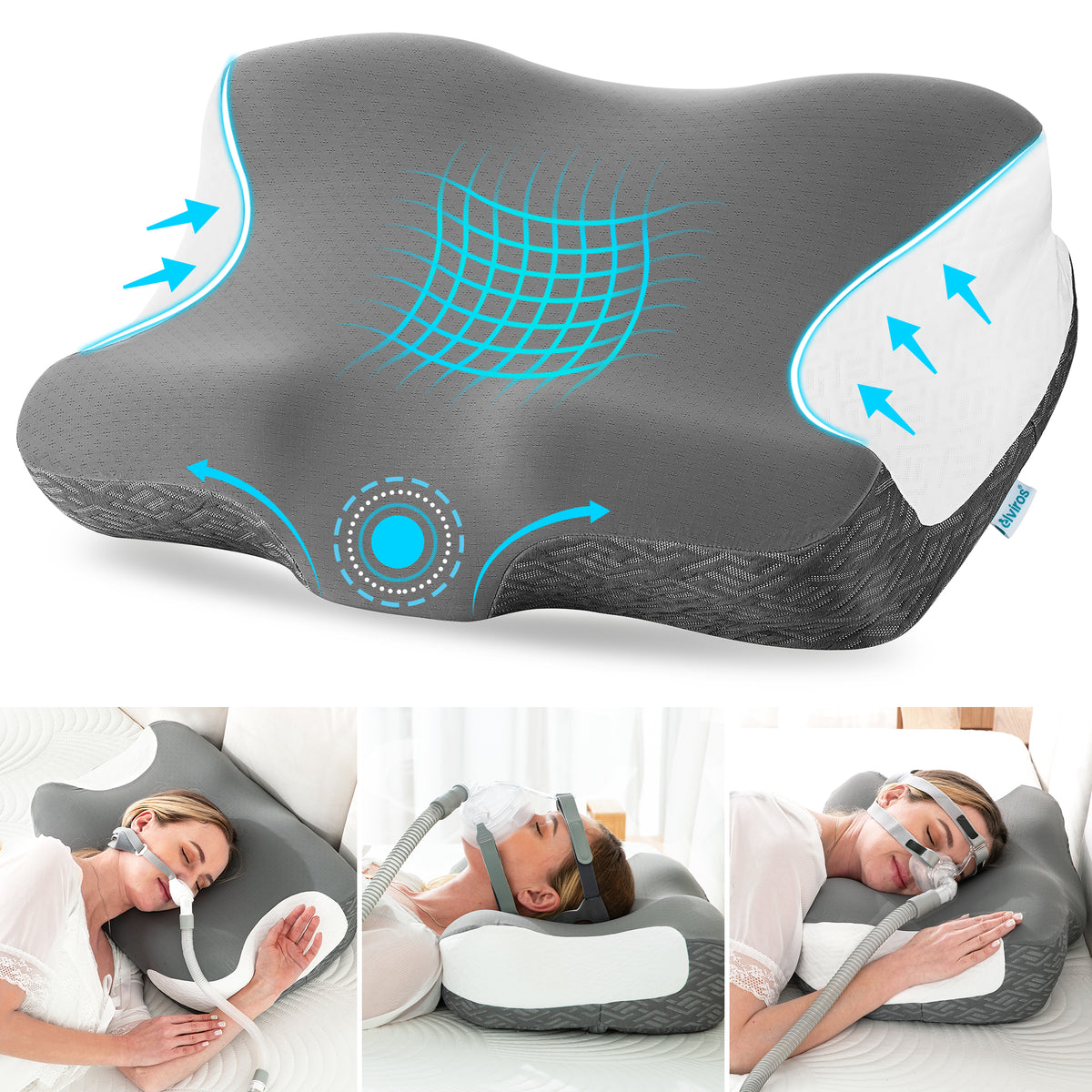
We sell the Elviros C2 Cooling CPAP Pillow in dark gray SKU DLZ10102DGWH004; check this exact configuration on the official C2 product page and specs before comparing numbers across listings.
What the C2 numbers are—and are not
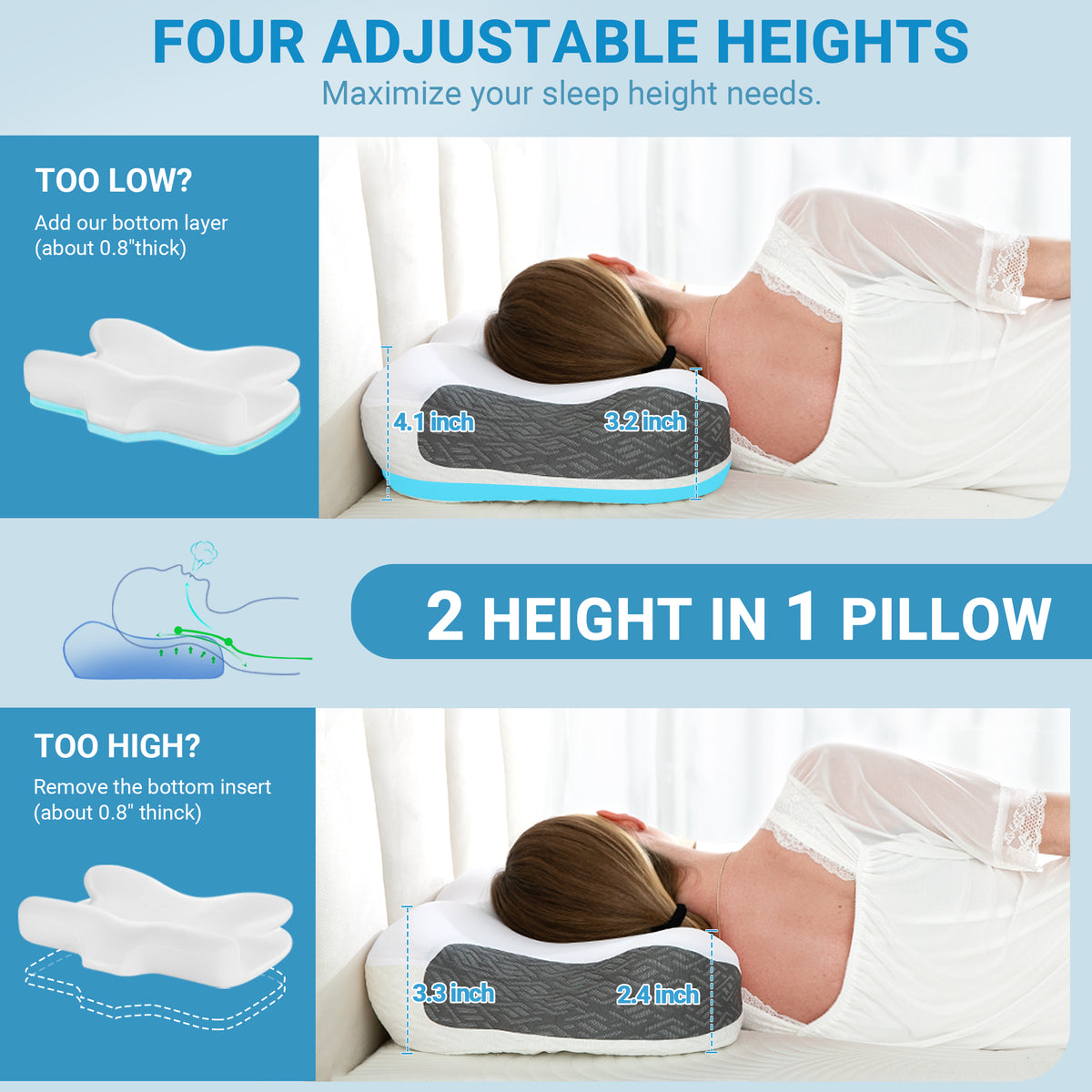
The C2 product copy and four-height graphic list high/low edge heights of 4.1/3.2 inches with the bottom base installed and 3.3/2.4 inches with the base removed; the base is labeled about 0.79 inch thick.
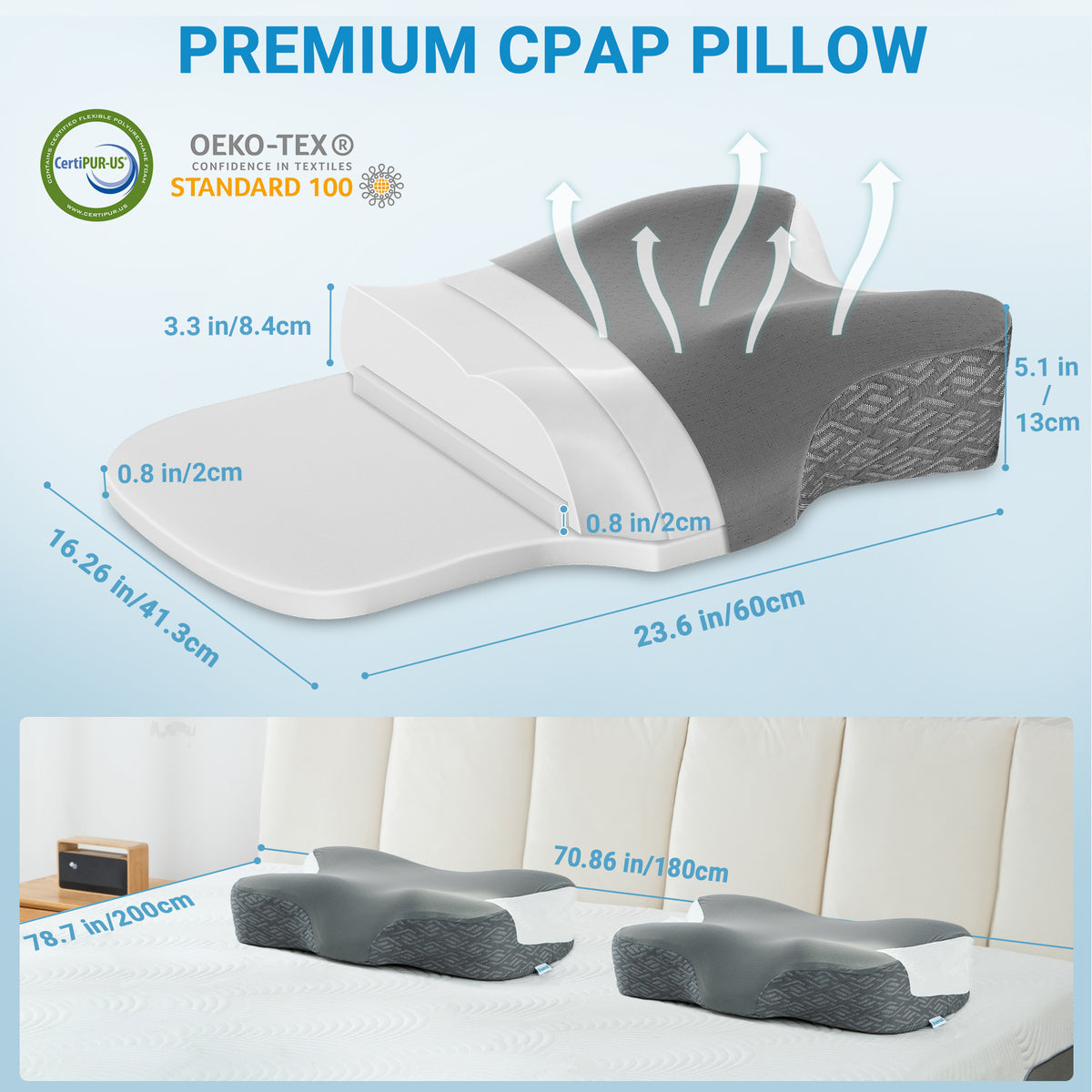
The same listing’s gallery also shows a structure image with a 5.1-inch label, but the pictured marker is at a different location and the seller has not explained whether it uses the same measurement point or configuration as the four-height graphic. I’m not treating the 5.1 label as a confirmed edge height, converting it into the other values, or calling it a mistake; it is an additional labeled marker whose reference is not explained.
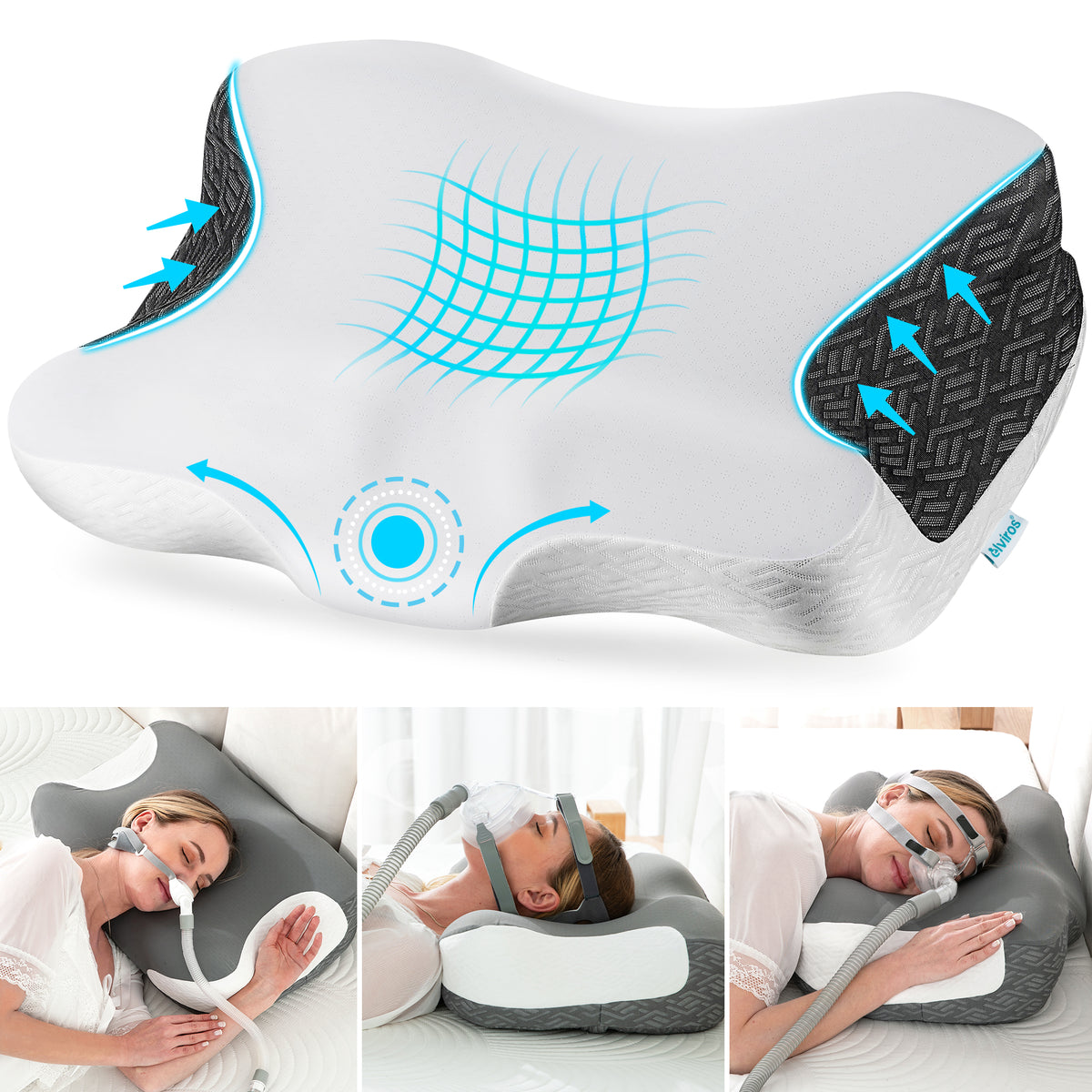
The C2 images show cutouts on both sides, but they do not provide verified cutout width, depth, or coordinate data. All of these are manufacturer labels, not independent measured heights.
Cross-brand number check
| Listing/source | Number(s) shown | What the number refers to | Do not use it for |
|---|---|---|---|
| Elviros C2 product copy + four-height graphic | 4.1/3.2 in with base; 3.3/2.4 in without base; base about 0.79 in | Edge heights on high/low sides for the stated base configuration; base thickness | Comparing a C2 low edge to another brand’s range minimum unless both confirm the same point and configuration |
| C2 gallery structure image | 5.1 in label | Additional pictured marker; equivalence to the four-height graphic is not explained | Converting, ranking, or confirming it as an edge height |
| Contour CPAPMax Pillow | Benefits: 2.25–5.25 in adjustable range; Size & Materials: 20 × 13 × 5.8 in external dimensions | Separate labeled categories: adjustable range and external dimensions | Treating 2.25 in as the same measurement type as a C2 edge height |
| Lunderg Memory Foam CPAP Pillow | Removable 1.1 in bottom layer | Component thickness | Calling it whole-pillow height or comparing it directly to a C2 low edge |
Why mask model matters only as a measurement reference
ResMed’s official guides show the AirFit F20 elbow at the front of the mask and the AirFit F30i elbow at the top of the frame. That structural difference is only a prompt to record the mask model you already use and where the connector sits before asking for pillow cutout data. It is not an adapter guide, fit prediction, or instruction for device use.
CPAP pillow for stomach sleepers: copyable pre-purchase worksheet
- labeled height with measurement point
- base insert status
- cutout dimensions
Copy this worksheet once per listing and fill the blank fields with your own notes.
| Field | What to write | If it is missing | Your notes |
|---|---|---|---|
| Product + exact configuration | Brand, product name, color/SKU if listed, and whether the base insert is installed | Do not combine numbers from another color/listing; ask the seller to confirm the configuration. | |
| Measurement category | Edge height, adjustable range, external dimension, base/component thickness, or cutout dimension | If the page mixes categories, stop and ask which category each number belongs to. | |
| Exact measurement point | Side (high/low), front/back if defined, left/right cutout, and whether the marker is on the top surface, edge, or base | Ask for a photo/diagram with the same marker; do not assume the pictured marker matches your need. | |
| Base insert status | Installed/removed; thickness if labeled | If height changes with the insert, require both states or the state you will compare. | |
| Cutout data | Side; width; depth; distance from stated edge/point; base state | If absent, ask for cutout width/depth and reference point for your recorded mask connector location. | |
| Existing mask reference only | Mask model and connector location: front vs top; no fit conclusion | Use only to request the corresponding cutout location; do not record “fits.” | |
| Data status | Comparable same-point data / seller confirmation needed / hold judgment | Choose hold judgment when the same point/configuration is not confirmed. | |
| Seller question to send | “For [product/configuration], at [same point], with base [installed/removed], what are the width/depth/reference point of the cutout?” | Send only the missing fields; do not ask for therapy or device guidance. |
Hypothetical example: A buyer comparing a CPAP pillow for stomach sleepers sees an edge height on one listing and a base thickness on another. The buyer does not compare those two numbers directly because an edge height and a base/component thickness are different measurement categories. Ask the seller for comparable measurements and keep the comparison on hold until the same measurement point and configuration within the same measurement category are confirmed.
When the images show cutouts but no verified cutout width or depth, the buyer records cutout width unknown, cutout depth unknown, reference point unknown, and base state required. The buyer does not estimate width or depth from the photo and does not combine the cutout note with an edge height or base thickness.
How to decide whether to ask for a missing measurement
- Ask when a number is required for your comparison and any one of these is unclear: measurement point, base state, whether the value is height/range/dimension/thickness, or cutout reference.
- Wait/hold judgment when the listing gives cutout shape but no width/depth, gives a second graphic marker without explaining equivalence, or lists external dimensions beside an adjustable range.
- Do not ask a seller to confirm treatment, mask fit, pressure, or device settings; keep the request to pillow dimensions and the labeled configuration.
Worked height notes to save
Elviros C2 source note: the official Elviros page lists four pillow heights for the CPAP version, 3.3 inches and 2.4 inches without the base and 4.1 inches and 3.2 inches with the base. A separate 5.1 inch marker appears in the material, but it is not reconciled to those two base states.
Save it as “5.1 in marker, relation unconfirmed.” It cannot move into a low-edge column because its side and base state are unknown. It cannot move into a high-edge column for the same reason. Do not average it with 2.4 inches or 3.2 inches. Do not use it as proof that the with-base high edge is 5.1 inches. The page also gives no cutout dimensions, so any mask cutout width, length, or depth cell stays blank.
Contour CPAPMax source note: the official Contour page gives an adjustable range from 2.25 inches to 5.25 inches. Treat that as a setting range, not as a labeled low edge that matches another pillow. If a worksheet has one column for fixed low edge, 2.25 cannot be pasted there unless the column is renamed to adjustable minimum. The 5.25 inch number belongs in an adjustable maximum field. It should not share a row with a fixed 3.3 inch edge as if both meant the same thing.
Lunderg source note: the official Lunderg page describes a 1.1 inch removable bottom layer. That number is a component thickness. It is not total pillow height. In a worksheet it can enter only a bottom-layer cell. If there is no bottom-layer column, create a note or leave total height blank. Do not add the 1.1 inch layer to a guessed top height unless the page states the assembled total. For a CPAP pillow for stomach sleepers, the saved line should still read “1.1 in removable bottom layer only.”
Column rule: a number can move across only when the label, base state, adjustment setting, and component role all match the column header. If one part is missing, the number stays in the source-note cell.
Check the uncompressed edge height
Ask for edge height at the left side, right side, and cutout rim. Each value must start at the same base point and end at the same top edge. If the listing shows only a range, ask whether the low and high values include the base layer. Request a side photo with a ruler resting beside the foam, not pressing into it.
If the seller sends a compressed photo, the data is not the same as the listed range. Reply and ask for the rest measurement, the base layer rule, and the exact spot used for the top edge.
Check one documented C2 reference
Ask for one item that ties the listing to the C2 model and packaging. Acceptable proof can be packaging wording, a label photo, a manual cover, or a diagram sheet that matches your saved four-height reference. Do not accept a generic pillow photo, a lifestyle image, or a collage as the reference. Place it next to the original Elviros C2 four-height diagram and compare model text, panel layout, and height labels. If any wording differs, ask the seller to explain the difference in writing before you treat the listing as comparable.
Ask for cutout geometry
Ask for the cutout inner opening width and depth, rim width, wall slope, and the distance from the nose edge to the center. Ask whether each measure starts at the inner opening or the outer cut edge. Request a top-down tracing with a ruler and a side photo along the channel. Curved arrows and phrases such as contoured are not geometry. If the cutout walls taper, ask for the opening at the top and the opening at the base. That keeps the channel shape from being confused with the outer pillow edge.
Seller email you can copy
Subject: C2 reference, edge heights, and cutout measurements
Hello, I am comparing your listing with the original Elviros C2 four-height diagram. Please send one packaging or model reference for the C2. Please send uncompressed edge heights for the left side, right side, and cutout rim. Please say whether each height includes the base layer. Please send cutout geometry with inner opening width and depth, rim width, wall slope, and nose edge to center distance. A top-down tracing with a ruler is enough.
Thank you, [Name]
Actionable replies
If the data uses the same points and states the base layer rule, reply: Please confirm these are uncompressed rest measurements from the base layer to the top edge, and keep this thread as the listing reference.
If the data is ambiguous, reply: Please pause my order question. Send one C2 packaging or model reference, the uncompressed edge height points, and a top-down cutout tracing with a ruler. I will compare again after those arrive.
Red flags to note
Move on when the seller swaps diagram sources, adds a new model name after you ask, sends only stock images, or describes feel instead of points and edges. Keep your notes short and store screenshots with dates.
Phone shopping for a CPAP pillow for stomach sleepers
On a phone, the fastest mistake is comparing photos before comparing labels. Start with the title and copy the exact model string. Keep the listed point with it, word for word, before opening anything else.
- Title: Match the full model name, not a shortened store name. If the point is in the title, keep that pair together.
- Technical specs: Scroll for rows that carry the same model string and same point label. Ignore rows that only describe a part.
- Alt or gallery card: Open the gallery captions and read visible labels on the photos. Use the dark gray and white gallery photos for shape and marker context only. Do not use alt text for inventory, version, or height inference.
- Variant selector: Tap each variant and watch whether the model string, point label, and gallery set change together. If the photo stays put while the label changes, do not treat the photo as proof.
- Vendor response: Ask for the official spec row or graphic that ties the model, point, and structure marker together. Treat reassurance as unverified until it names the same model and point.
A comparable product note can be short: same exact model, same point label, same marker context in the gallery, and the structure image used only as a marker reference. If one value is a component thickness, write it as a component thickness.
A hold is different. Use a hold when the only shared value is a component thickness and the point label does not match. Also use a hold when the structure image shows the separate 5.1-inch marker but the listing does not tie that marker to the exact point. The separate marker is a reference, not proof of equivalent point or configuration.
Comparable note versus hold
Comparable note: exact model string retained, exact point retained, gallery view used for context, component thickness named as a component value, official four-height graphic cited for the point.
Hold: similar photo, same family name, same color family, or one shared thickness value while the point label differs. In that case, keep the listing in research status and do not merge it with the verified note.
For the structure image, keep the boundary narrow. The image shows a 5.1-inch marker distinct from the four-height graphic. That is useful for locating a measurement reference. It is not, by itself, evidence that two listings share the same point or configuration. If a listing needs that connection, cite the official graphic and keep the claim tied to the exact model and point.
What I can verify on arrival vs what still requires seller data
I can verify the model string on the tag or packaging. I can verify the point label printed with the product. I can verify which variant was selected in the order record. I can compare the included pieces with the listed configuration. I can check that the gallery views I saved match the received color and shape context.
I can also confirm whether a separate structure marker appears in the official materials I already saved. I cannot use arrival alone to prove that a component thickness equals the listed point. I cannot infer a version from a gallery photo. I cannot infer stock status from color.
What still requires seller data: the current official spec row for the exact model and point. The meaning of any component thickness value. The official graphic that connects the separate 5.1-inch marker to a listed configuration. Confirmation that no substitution changed the point label, gallery set, or included pieces.
Keep the worksheet language separate from the seller message. Save the comparison as evidence. Mark unknowns as unknown. Move a listing to comparable only when the exact model, exact point, and official graphic alignment are all present.
For readers checking C2 specs, use the pillow-loft guide for a repeatable home loft reference and the C2 buying checklist for fields to confirm with the seller; neither is a mask fit test or a compatibility conclusion.
Leave a Reply