An adjustable firmness CPAP pillow can mean more than one mechanism, so the useful question is not whether a pillow is adjustable. It is which named part changes sleeping height, which named part changes feel, and whether those jobs are separate or tied together.
Table of Contents
The Lunderg Travel listing describes a removable layer for height (Lunderg travel CPAP pillow product page). The Lunderg Parkin CPAP pillow uses loose fill for loft and firmness, with no guarantee of direction or magnitude when fill is added or removed (Lunderg Parkin CPAP pillow product page).
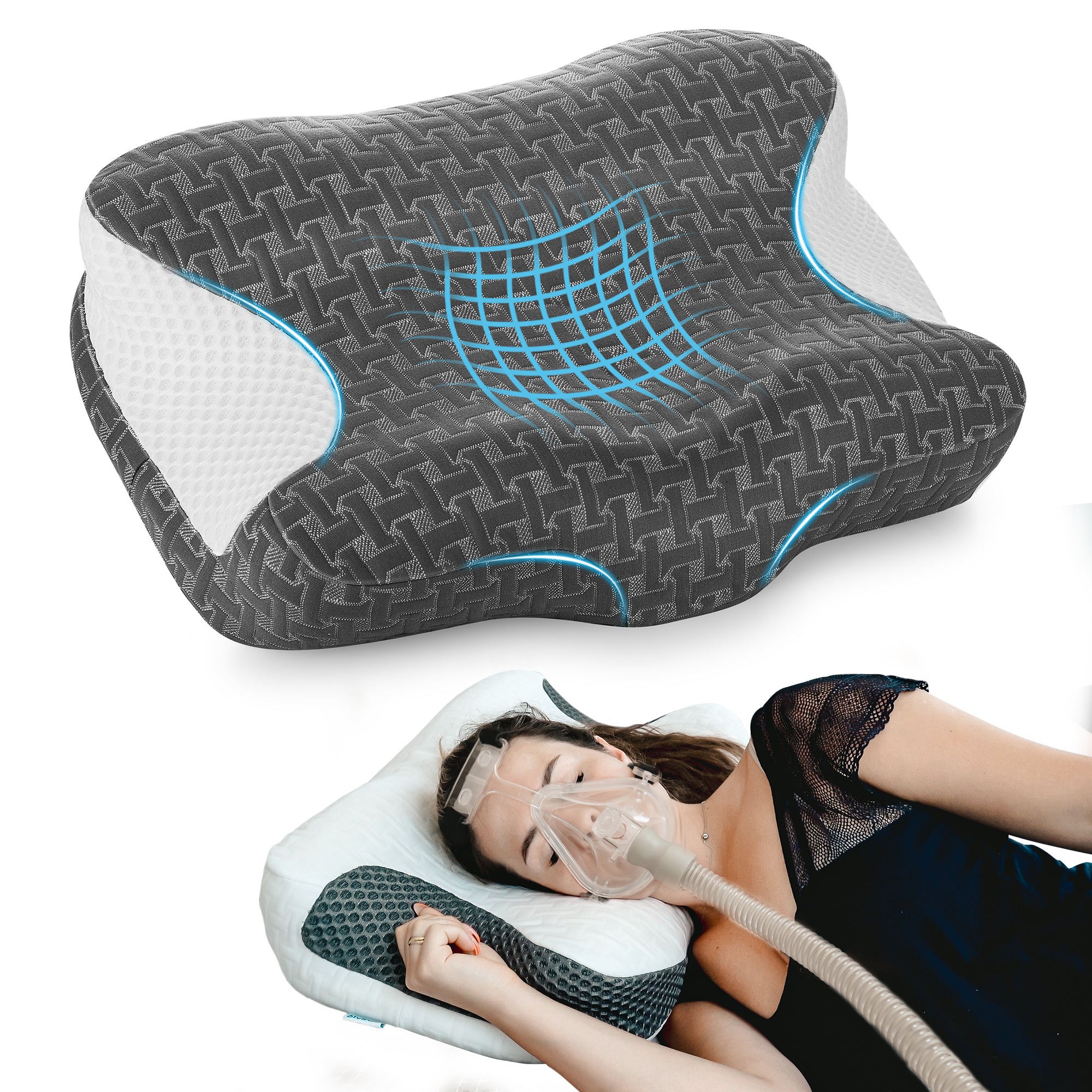
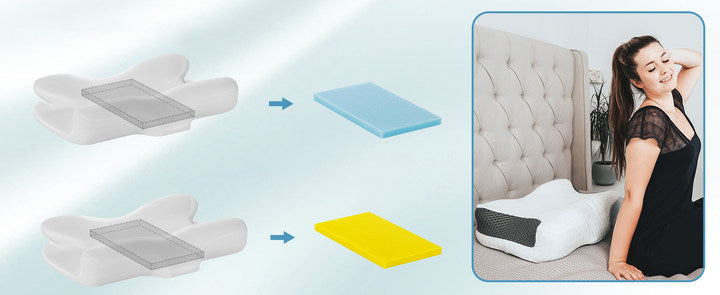
The C1 listing describes rotation and a removable base to adjust height, plus two separate interchangeable inserts to adjust feel (Elviros C1 CPAP pillow product page).
Pick an adjustable firmness CPAP pillow by named controls
How to read an adjustable firmness CPAP pillow listing
Start with controls, not adjectives. A listing may say adjustable because one foam layer removes, because fill can be moved, because the pillow rotates, or because a feel insert swaps. Those are different purchase decisions. Name the height control first, name the feel control second, and only then compare price, materials, or photos. If the same loose fill controls both height and feel, changing one can move the other. If a base controls height and an insert controls feel, you can often test one variable while leaving the other in place.
Use three labels while you read. Fill means loose or synthetic-down material that can be added or removed. Base means a removable bottom layer, spacer, or firm slab that mainly changes height. Feel insert means a separate component intended to change firmness or surface feel. The C1 product page FAQ expressly describes 180-degree rotation and a nominal 0.79-inch removable bottom base. The C1 listing describes the two exchangeable feel inserts. The Travel listing describes a removable 1.1-inch foam layer. The Parkin listing describes synthetic down filling that adjusts height and firmness.
Orientation and Base Shopping Map
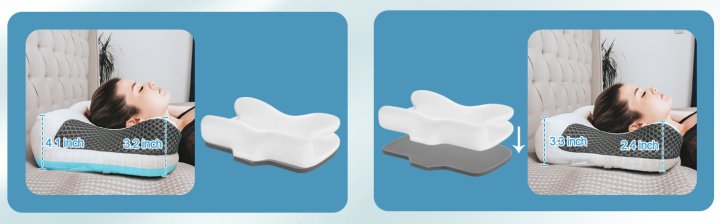
Use this map right after the setup terms, before comparing sellers. The four published nominal edge choices are: lower edge without base 2.4 in, higher edge without base 3.3 in, lower edge with base 3.2 in, higher edge with base 4.1 in.
Treat all four as nominal listing specs, not in-use measurements. The official C1 base graphic shows the removable bottom layer and the same manufacturer figures near people; use it for orientation only. It does not show your body, mask, hose pull, sheet tension, or room setup.
Start with a current unloaded baseline. Lay your present pillow on a firm flat table, remove bedding, and measure lower and higher edges at matching points. Record surface, ruler type, date, and whether the feel insert was inside.
Worked example (hypothetical only—do not apply these numbers without replacing them with your own): take the current pillow’s unloaded reference edge as 3.2 inches; for the C1, a nominal 3.2 refers to the lower edge with the removable base installed, while a nominal 3.3 refers to the higher edge without the base, so the difference between those two values is 0.1 inch, even though one of them matches the 3.2-inch reference figure and the two describe different configurations.
Because the same number can label different setups, ask the seller which side and which base option correspond to the variant you select, and note that the lowest edge listed is 2.4 without the base; this example compares listed dimensions only, does not recommend any particular setup, and does not assume fit or comfort.
Do not merge 3.2 and 3.3. A 3.2 in lower edge with the removable base uses a different edge and build than a 3.3 in higher edge without it. Matching height words do not make the same configuration; compare edge name, base state, contents list, and unloaded baseline separately.
Product photos have no reliable scale; use a reference diagram only to identify components. Make the decision orientation-first: name the edge facing the buyer, confirm whether the removable base is included, then match the nominal catalog setting to that setup.
Fill, base, or feel insert: the comparison
| mechanism | what it changes first | how you change it | what to verify before ordering | clean reversal test |
|---|---|---|---|---|
| loose fill or synthetic down | height and firmness together | add or remove fill | whether the listing names a fill opening, how the fill amount is documented, and whether your exact variant is the one shown | return to the original fill amount, then recheck listed dimensions, your unloaded measurement, and perceived height |
| removable base or layer | height, with feel possibly changing indirectly | remove or replace the stated layer; note the listed direction if given | whether the layer belongs to your exact variant and whether any photo-only part is sold separately | reinstall the base or layer, then compare perceived height before trying a feel change |
| exchangeable feel insert | feel, with perceived height possibly changing even if height parts stay fixed | swap only the insert named by the listing | whether the insert is included for your variant, how many inserts ship, and whether the cover, cavity, spacer, or shell is shared | reinsert the original feel part, then decide whether the earlier change helped enough to keep |
Hypothetical scenarios: same complaint, different fix
Hypothetically, the buyer wants a lower side-sleeping edge height while keeping the current back-sleeping setup unchanged. They would record the current edge heights as side __ inches and back __ inches, then ask the seller for comparable C1 side and back edge heights and how the base affects each. If the seller confirms only a whole-pillow change, the buyer should not assume the back setup is preserved and should choose either to keep the current pillow or look at other models.
A traveler deciding between the Travel pillow and the C1 should buy for the constraint that is hardest to fix later: the Travel pillow when a listed removable height layer is the whole requirement, the C1 when separate feel control matters more than travel shorthand, and neither until the exact variant contents are confirmed.
A shopper replacing a loose-fill pillow after undocumented add-and-remove sessions should read ‘adjustable firmness CPAP pillow’ as a mechanism audit, not a promise: if fill edits changed height and feel together, do not reorder the same loose-fill design; order a named separate-control design only after the seller confirms the exact variant, otherwise keep the current pillow and finish the worksheet first.
Buyer matrix
| situation | what to change first | what to compare |
|---|---|---|
| height feels right but too firm | with separate parts, swap only the firmness insert; with loose fill, try one small reversible fill change only if documented | feel and perceived height while awake, then recheck height if fill moved |
| too low and too firm | use the documented height adjustment first; reassess feel after the height test | perceived height first, then feel; if loose fill changed, recheck both |
| unsure | compare the current setup against one easy-to-undo change | that one change versus the current setup; revert if the result is unclear |
One-change check: listed dimensions, unloaded measurement, perceived height
Keep three meanings separate. Listed dimensions are the values stated on a product page; for the C1, the product page FAQ gives 23.6 by 16.3 inches and lists edge heights without the bottom base as 3.3 and 2.4 inches and with it as 4.1 and 3.2 inches, all nominal and attributed.
Unloaded measurement is your own consistent check on a flat surface at the same spot, before the pillow is loaded by your head, mask, or sleeping position. Perceived height is how high the edge feels when you are lying in your usual position. Treat those as separate observations: a listed value is not your measurement, your unloaded measurement is not a loaded or perceived outcome, and perceived height may or may not track the unloaded number.
Run the check this way. Keep the product’s listed values for reference; they do not change during a home comparison. Measure unloaded height the same way every time. Lie still long enough to judge perceived height. Change one allowed part. After each change, record the unloaded observation and the perceived observation, while leaving the listed values as reference. If the result is unclear, revert that one part and stop. If the result is clear and better, keep the change and only then test a second variable.
Variant Capture Checklist
Color swatches can change the gallery before the words catch up. When switching colors or configurations, capture the model name, exact selected option, itemized contents evidence, and conflicting source info from the actual listing. Save screenshots with the option box.
Hypothetical offers: Offer A says “white contour, with feel insert and removable base,” then repeats that pair in contents. Offer B shows the same white photo but lists only the contour pillow. Offer A is clearer; Offer B needs a question before cart.
If they conflict, do not average them. Message the seller from the listing: “For white contour, which listed parts ship? Confirm against the selected variant, not the gallery image.” Paste the answer beside your screenshots, then reconfirm the cart line before any purchase step.
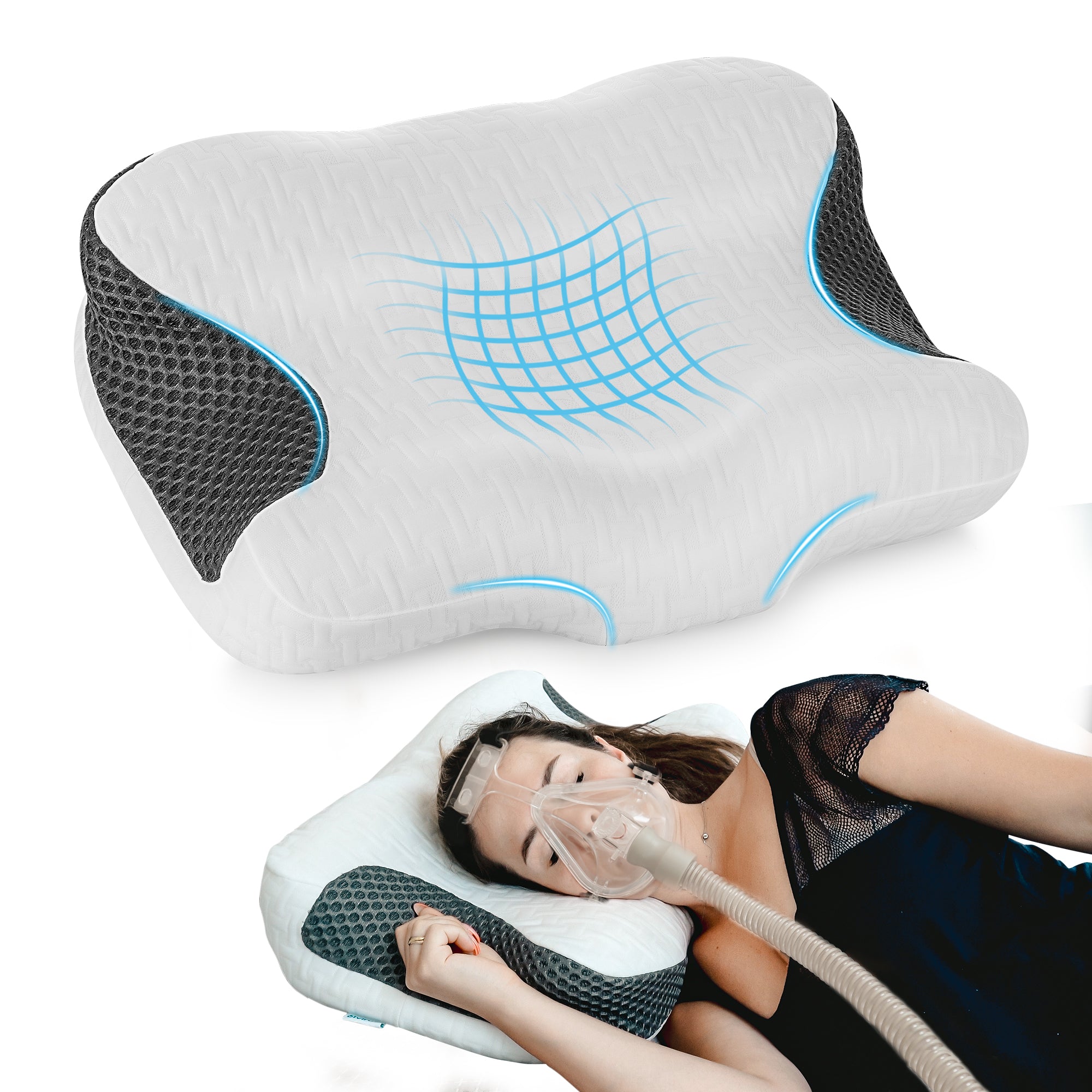
A second official gallery image shows the white C1 contour illustration and a masked person. It establishes visual identification only: white example, contour shape, mask context. It does not prove which parts ship, and it makes no comfort or airflow statement.
Before checkout, make one row: date, model, selected option, photo filename, contents text, conflict note, seller answer, cart check. Reconfirm in cart without committing to buy. If the cart drops the option or swaps the photo, stop and reset.
Order-specific worksheet you can reuse
Before checkout, fill in the listing and seller fields below, and optionally measure the pillow you already own as your comparison baseline; leave measurements of the new pillow until it arrives.
- product and exact variant or SKU: ____
- listed dimensions for that variant: ____ by ____ inches
- listed edge heights, if stated: without removable base ____ and ____; with removable base ____ and ____
- height control named by the listing: rotation ____ / removable layer ____ / loose fill ____ / not stated ____
- feel control named by the listing: exchangeable insert ____ / fill amount ____ / not stated ____
- included inserts and layers for my variant: ____
- photo-only items and anything sold separately: ____
- seller reply received: yes or no
- exact seller sentence that proves the height control: ____
- exact seller sentence that proves the feel control: ____
In-hand fields: after receipt, or with your current pillow as the comparison baseline
- my baseline surface and spot: ____
- baseline unloaded measurement: ____
- baseline perceived height when lying still: ____
- the one change I will test first: ____
- why that change is reversible: ____
- revert point if feel or support becomes unclear: ____
- decision rule: stop if ____; continue only if ____
A seller question you can copy, print, and reuse
Paste this into any pillow listing’s Q&A or chat before ordering: Which exact part of this pillow changes sleeping height, and which exact part changes firmness or feel? For the variant I would receive, please list every insert and layer included, the available settings for each, and any parts shown in the photos that are sold separately.
It asks for exact parts, your specific variant, and anything sold separately. Those are the details that turn adjustable from a label into a decision you can test and reverse.
Hypothetical seller replies and a stop/continue decision
Hypothetical reply that supports continuing — clearly invented generic example, not a quote or source: ‘Confirmed: this is the exact adjustable-firmness CPAP pillow variant for this listing, and firmness is set by one shared loose-fill control.’ A separate-control answer would also pass when it names the exact variant and the control type; nothing here implies any C1 box contents.
Hypothetical reply that should make you stop or ask again: the seller only repeats that the pillow is adjustable and says to add or remove material until it feels right. That answer does not name the height part, the feel part, the variant contents, or the sold-separately parts.
Continue only when the reply names the exact variant and documents its control. A documented shared loose-fill control is a valid option if you accept that loft and feel are adjusted together; separate controls matter only if you specifically need them. Stop whenever the instructions or the exact variant contents are unknown or conflicting.
Five checks before you buy
- Name the height control: identify whether height is changed by rotation, a removable base, loose fill, or more than one method, and note the listed direction if one is given.
- Name the feel control: look for a swappable insert or a documented add/remove fill method, and write down the actual firmness mechanism.
- Check shared components: see whether the height base and feel inserts share a cover cavity, spacer, or shell; do not assume separate controls use separate parts.
- Confirm the boxed variant: exact SKU box contents are unknown here, so match listing photos to the model number or ask the seller what ships in the box.
- Change one variable, then revert: keeping hardware fixed does not guarantee loaded height, so compare one allowed change at a time; if feel or support is unclear, revert before trying another.
Measure results instead of guessing
Feel is subjective; height does not have to be. Our guide to measuring and comparing pillow loft shows a consistent way to check height before and after each change. Measure the same way every time so the number reflects the pillow, not your method. Do not treat an editorial example as a measured compressed height, a fit promise, or a product outcome.
Receiving and Purchase Decision Record
Photograph the sealed box, label, and all sides before opening. Open on a clean surface and lay out every part in one line. Match each piece to the selected variant’s contents list: cover if listed, pillow core, feel insert when listed, and removable base when listed.
Identify parts by listing names, not memory. Check tags, embossed marks, seam shapes, zippers, fabric direction, and layer edges. Test nothing yet; first prove what arrived. Mark unclear pieces: “tag unreadable,” “layer count unknown,” or “matches photo only.”
For a missing or unclear piece, record three lines: what the selected variant promised, what the box contained, and what remains unverified. Ask the seller for written identification or instructions using those lines. Keep ruler notes separate from seller wording.
At receiving, save the order number, SKU or variant code, and any part codes printed on the box, base, inserts, or instruction sheet; photograph labels before opening bags. Mark each item as confirmed from packaging, photo-only, or unknown, and keep the reason beside the code instead of filling gaps.
Do not post names, addresses, phone numbers, serial photos, or full order pages in a public review; share only the codes needed to explain the variant. Before handling an unclear base, insert, or loose hardware, ask the seller privately for the exact variant instructions and a parts list, then proceed only with the items listed for that variant and keep that answer with the receiving note.
Example handoff note: “Quote/label: selected white contour with listed parts. My findings: core and cover present; soft insert present; base layer present but thickness unmeasured; no unloaded ruler test yet.” That separates source text from observation.
After the record is complete, write the decision: keep, exchange question pending, or stop. Base it on the selected variant, arrival record, and seller’s written answer. Do not let a gallery photo, similar height number, or rushed unboxing replace the checklist.
Where the Elviros C1 fits
The C1 matches the two-controls pattern: rotation and a removable base for height, plus two exchangeable feel inserts separate from that base, per the official listing. The product page FAQ gives the nominal dimensions and edge heights above. No per-variant box contents or loaded dimensions are verified in this article, so use the worksheet and seller question before treating a photo as your exact contents.
Elviros sells the C1, so we’re not a neutral party. Treat this as a seller’s suggestion, and confirm your variant’s contents with the question above before you buy the whole pillow.
Leave a Reply