Contour and cervical are overlapping labels, not distinct product types: contour simply describes a shaped profile, while cervical refers to the neck area the pillow supports, and neither term by itself proves fit or results. When you're comparing two listings — the practical contour pillow vs cervical pillow question — check the actual shape, where each height is measured, and which cover the maker lists for that model.
Table of Contents
Disclosure: Elviros sells the S1, which is the one purchase option this guide is built around. The Elviros C2 and the Core Products Tri-Core Full appear only as examples of how to read listings across brands; they are not recommendations, and no ranking is implied.
Contour pillow vs cervical pillow: what the labels can and can't tell you
Terminology write-ups from Sidney Sleep and Dosaze describe the same overlap — curved, contour, and cervical wording blurs across listings rather than sorting pillows into separate classes.
- Read 'cervical' as an indication of the neck area the seller is aiming the pillow at.
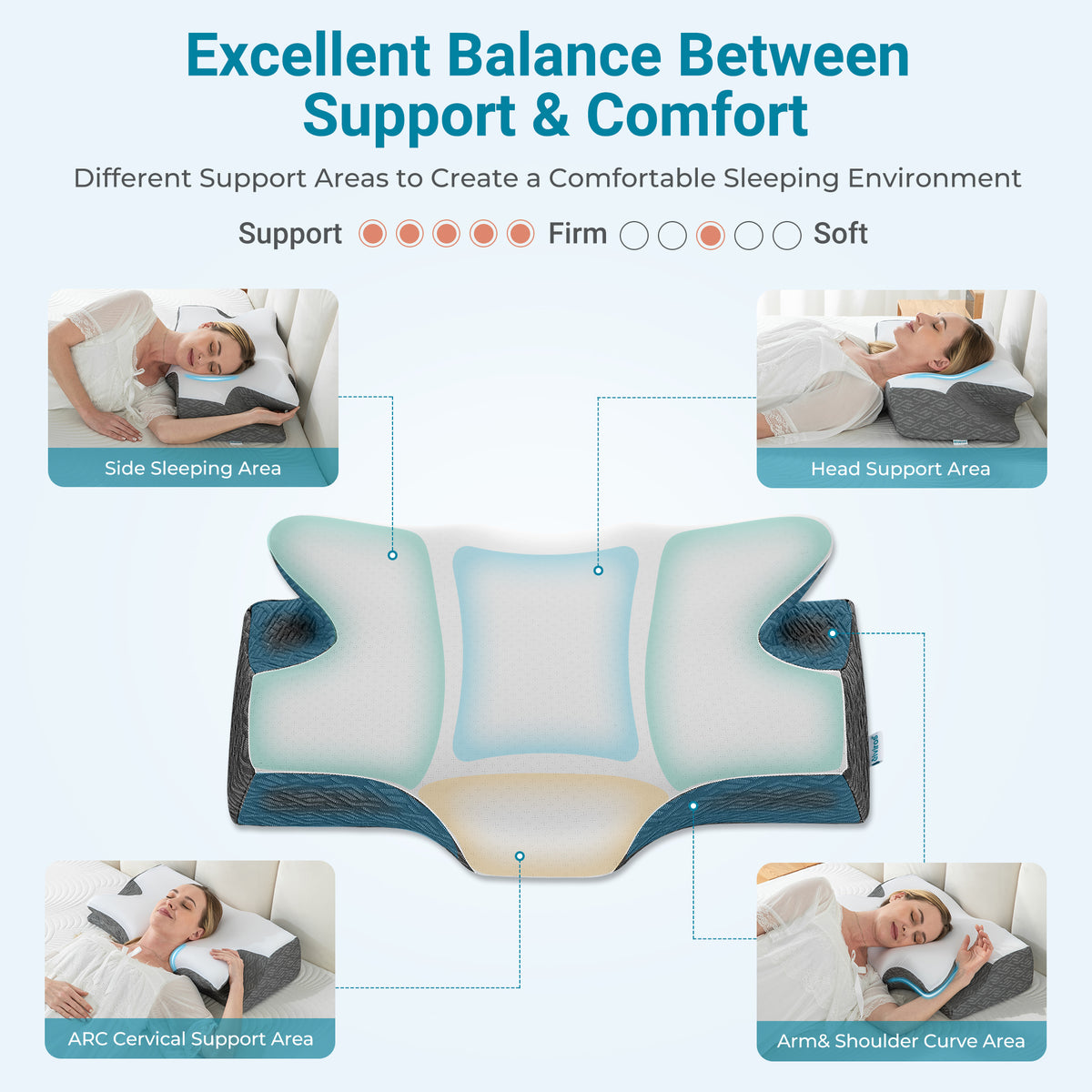
- The C2 listing uses both terms in its FAQ, where it calls the model a cervical contour pillow. When a listing uses both labels, look for a diagram and the actual dimensions before you compare models.
Read three real listings side by side
| Exact model | Shape wording | Listed length × width | Listed height and measuring point | Case information |
|---|---|---|---|---|
| Core Tri-Core Full (Core Products) | Recessed trapezoid center | 24 × 16 in | 5 in, point not stated in spec row | Maker states a standard-size pillowcase works |
| Elviros S1 Cervical Neck Pillow (Queen / King) | Shoulder-cutout shape | Queen 26 × 16.5 in; King 28 × 16.5 in | Not stated by the size selector | Dedicated S1 cover listing with two length-labeled options |
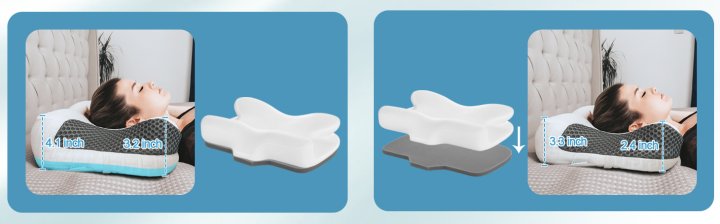
| Elviros C2 Orthopedic Pillow for CPAP Users | Side cutouts and paired edge heights | 23.6 × 16.3 in | Two edge heights: 3.3/2.4 in without base; 4.1/3.2 in with base | Elviros C2 Pillowcase, No Filler |
Published length and width give you a first-pass comparison of how much bed space each pillow takes, but brands may measure differently, and length and width alone cannot tell you whether an existing case or pillowcase will fit; confirm the outline, depth or profile, closure type, and the exact model and size before buying.
Worked example: which published numbers can you compare?
Say you are weighing the Core Tri-Core Full against the Elviros C2 — a typical contour pillow vs cervical pillow pairing, since the two listings lean on different label wording — and you want the taller-sided option. Core's spec row shows 5 in of product height, but it does not say where that height is taken. The C2 shows paired edge heights — 3.3/2.4 in without its removable base, 4.1/3.2 in with it. Setting 5 next to 4.1 looks like a comparison, but it is not: one number has no stated measuring point, and the other is a pair of named edge heights tied to a specific configuration. Change the configuration — remove the C2's base — and its published numbers change too.
As a worked example using published figures only: the Core measures 24×16 in, the S1 Queen 26×16.5 in, and the C2 23.6×16.3 in, so the S1 Queen has the greatest listed length and width of these three variants and the C2 sits between them on width; these are bed-space comparisons, not height or loft data, which should be measured per the pillow loft guide.
How to avoid a mismatched cover
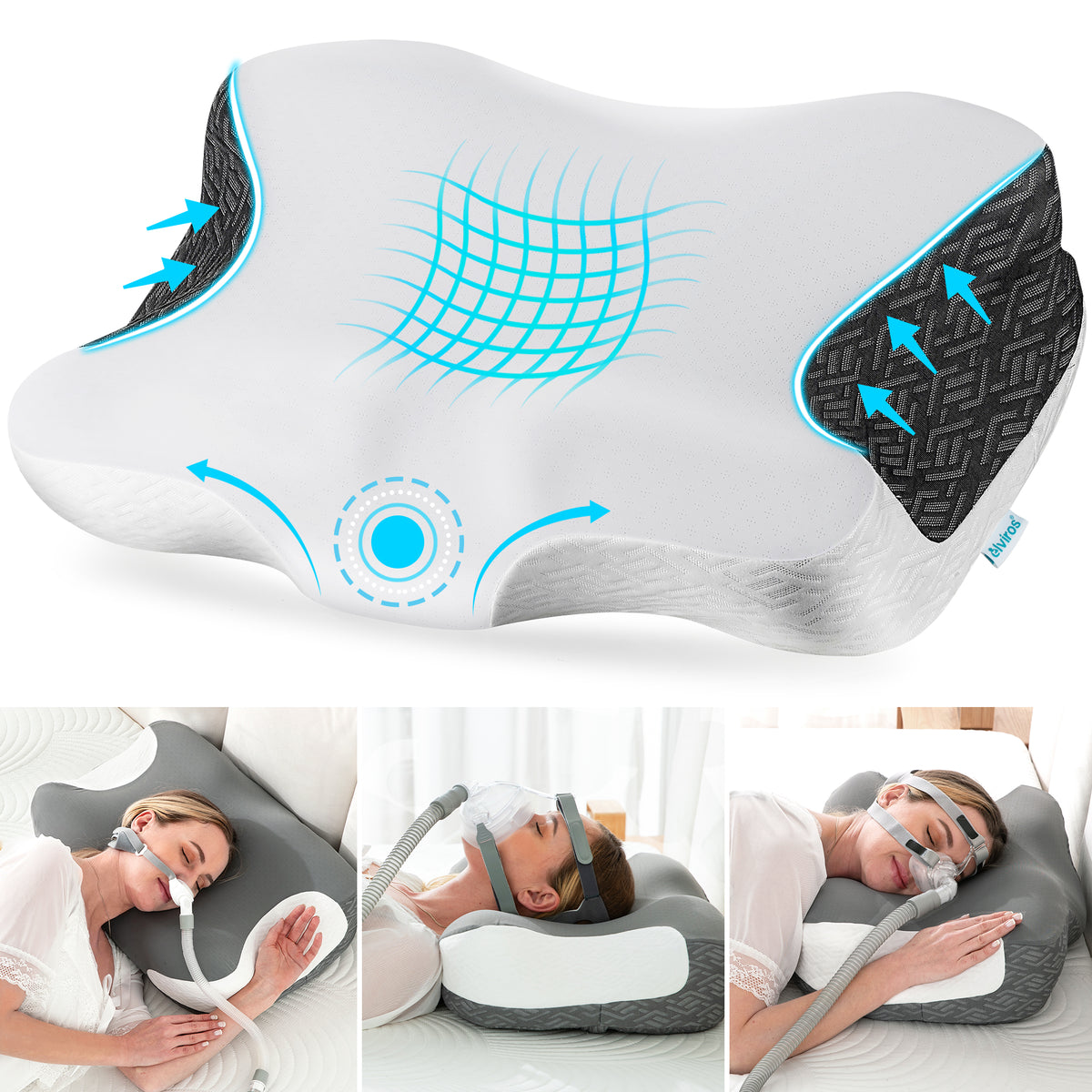
After a contour pillow vs cervical pillow search, the easiest mistake at this stage is buying a cover off the word 'cervical' alone. The fix is boring but reliable: match the cover listing to the exact model name and size option.
- The S1's cover maker lists two length-labeled options, 26 and 28, so match your exact S1 order size to the corresponding cover label, and treat those labels as cover identifiers rather than measured pillow heights.
- For the C2, the cover is sold as a cover-only listing for that exact model. Do not assume it fits the S1, and do not assume fit or material carries across models.
- Core's standard pillowcase recommendation applies to its own Tri-Core model specifically; it is not a general result for any 24×16 in pillow, so do not assume it crosses over to the S1 or C2.
- Treat no cover here as universally compatible. Any cross-model fit claim is a question for the seller, not a spec you can verify from the label.
A 4-point checklist before you shortlist
- Exact model name. The listing names the precise model — for example, Elviros S1, Elviros C2, or Core Tri-Core Full — not just 'cervical pillow.'
- Footprint. Check each pillow's listed length and width against the bed space you actually have, and assess cover fit as a separate question from footprint.
- Stated measuring point. Every height number you compare is tied to a named point, like the C2's paired edge heights; if the point is not stated, do not use the number for comparison.
- Cover match. The cover listing names the exact model and offers a size option that matches your selector choice.
Pick the exact model you want, compare named height points across models or ask the vendor what they measure, and verify both pillow fit and cover fit against that specific item before you buy; a checklist narrows the question but cannot resolve every fit scenario on its own.
Label your screenshots so each dimension stays tied to its variant
Screenshots only help if you can tell, a week later, which variant was selected when you took them. Before you capture anything, set the size selector on the listing to the exact variant you are considering, then label the file with the model, the variant, and the date. A simple naming pattern works: S1_King_2026-11-10.png beats screenshot(3).png every time, and it keeps a Queen capture from being mistaken for a King capture later.
In the size selector, record the exact selected Queen/King variant and confirm the listing’s length/width label matches; do not expect a named height from that selector, because it only sets the Queen/King size while height must be verified from model details or the seller.
Reusing an existing case: check model, closure, and shape first
Here is a second scenario. A shopper already owns a pillowcase and wants to reuse it on a new pillow instead of buying a matched cover. The checklist logic is the same, but the order matters. First, the model check: does the case you own correspond to the exact model name on the new pillow's listing? A case sold for one model is not evidence of fit on another, and the article's table already shows the C2's cover is a cover-only listing for that model specifically.
Second, the closure check. Look at how your existing case closes — zipper, envelope flap, or another style — and compare that against any closure information shown on the cover listing for the model you are buying. If the closure type is not visible or not stated, that is an unknown, not a "probably fine."
Third, the shape check. Lay your case flat and compare its outline against the product diagram. The S1 has a shoulder-cutout shape and the C2 has side cutouts with paired edge heights; a case shaped for one outline will not necessarily accommodate the other's profile, even if the footprint numbers look close.
When any of the three checks is unresolved, send the seller a short message instead of guessing. Something like: "I own a case made for [model]. Before I order the S1 King, can you confirm whether this case's outline and closure match the S1, and whether the 28-length cover option corresponds to the King?" Keep it to the model, the closure, and the shape — three sentences is enough — and wait for an answer that names the exact model before you treat fit as settled.
A blank comparison worksheet you can reuse
Copy the template below into a notes app and fill one row per listing. Keep filled and unknown fields physically separate so an honest blank never gets mistaken for a confirmed number.
| Field | Listing 1 | Listing 2 | Listing 3 |
|---|---|---|---|
| Exact model name (check 1) | |||
| Listing URL and capture date | |||
| Variant selected in the size selector | |||
| Footprint: listed length × width (check 2) | |||
| Height number(s) shown | |||
| Stated measuring point for each height (check 3) | |||
| Shape wording from the listing | |||
| Cover listing names this exact model? (check 4) | |||
| Cover size option matches your variant? | |||
| UNKNOWN — height measuring point not stated | ☐ | ☐ | ☐ |
| UNKNOWN — cover fit not confirmed for my variant | ☐ | ☐ | ☐ |
| UNKNOWN — closure type not shown | ☐ | ☐ | ☐ |
A real buyer using this sheet for the three listings in this article would fill in, for example, "Elviros S1" in row one, then tick the unknown box for the height measuring point, because the S1 selector does not state one. The C2 row gets its paired edge heights filled in with their named points and configuration noted. Anything you cannot point to on the listing stays in the UNKNOWN rows.
If one fit-critical detail is still missing, defer the purchase instead of guessing. Record the seller’s answer exactly, with units and the specific model/variant, before ranking the options.
Pillow Listing vs. Cover-Only vs. Bundle: Read the Cart Before You Pay
Picture three hypothetical carts. Cart A: "contour memory foam pillow, standard size" at a mid-range price — one full pillow, nothing else. Cart B: "soft replacement cover for cervical pillow" at a fraction of that price — fabric only, no pillow inside. Cart C: "cervical pillow bundle with extra cover and travel pouch" — a pillow plus accessories in a single box. The titles rhyme, but the boxes that arrive would look very different.
To tell which cart you’re viewing, check three spots before paying: the item title for an explicit cover-only or pillowcase-only label; the included-items or “in the box” line; and unit count, which states how many units are listed rather than what each unit contains. Don’t rely on the photo alone, since a stuffed pillow may be shown for scale; confirm the label, included-items line, and unit count before paying.
If anything stays ambiguous, send one short seller question: "Does this listing ship the pillow itself, a cover only, or a pillow plus extras?" A single specific sentence invites a specific answer, while a vague "what is this exactly?" earns a copy-pasted description. Keep the reply in your messages in case the box differs.
Pillow Footprint vs. Limited Bed Space
Suppose you sleep against a wall and find the mattress edge by feel at 2 a.m. Cut newspaper to the pillow's listed length and width, lay the sheet where your head lands, and lie down. Trace it on both sides if you switch orientation during the night.
For a headboard ledge, measure the ledge's usable depth and compare it to the pillow's listed depth, then set the traced outline on the ledge to see whether it perches or overhangs. If a second pillow shares the bed, trace both side by side with a few inches between them — a shape that fits one pillow neatly may crowd two.
When taping, measure usable mattress width from wall to edge, not across the bedding, since the pillow sits on the mattress itself. Mark where your shoulders rest, because your body, not the pillow outline alone, defines the space you actually occupy.
Compare height only when the measuring point and the unloaded or loaded measurement are both stated. A listed height does not establish how it feels. A tracing estimates space only.
Contour Pillow vs Cervical Pillow: Reading the C2 Height Drawing
The C2 height drawing labels two edges and shows how an optional base changes their heights. Use only the established figures: 3.3/2.4 without the base, and 4.1/3.2 with it. Those labels are the controlling evidence; they are not extra thickness inferred from shadow, fabric loft, or a hand pressing the foam.
The staged listing photo can still help with proportion, colour, and packaging, but it is different evidence. Perspective, lens compression, bedding texture, and a nearby shelf edge can exaggerate or hide height. If the pillow appears beside books, a headboard, or a phone, that only suggests context. The labelled C2 dimensions remain the numbers to trust, and the optional base should be read as a separate state rather than a silent addition.
For shelf storage, check the highest labeled edge in the configuration you plan to store. If a competing pillow has no labeled height or the measuring point is unclear, ask the seller before deciding whether it fits.
For support, compare by intended edge rather than by marketing label. A contour pillow may expect one edge under the neck, while a cervical pillow name may signal posture more than a universal height. The drawing supports edge-specific choices: 3.3/2.4 for the lower state, 4.1/3.2 when raised by the base.
Contour pillow vs cervical pillow: outline checks when listings disagree
When listings show different orientations, normalize the view before judging the outline. Put both shapes on the same imagined flat surface, choose a fixed reference edge, and compare the outer silhouette only after mirroring or rotation is accounted for, including the outer shoulder roll, before any silhouette conclusion. A thumbnail turned for page design can make a gentle cervical wave look like a steep contour, while a true side profile may reveal the opposite.
Hypothetical example: rotating a graphic is not the same as turning the physical pillow. If a seller rotates the product photo so the brand label reads upright, the curved shoulder, central saddle, and high edge can trade apparent width and height on screen. If you turn the pillow itself so that same label faces you, the seam, zipper line, and contour apex keep their physical relationships in that orientation, not screen position, so the outline comparison stays meaningful.
For measurements, ask for values that are comparable across views: overall length and width on a flat surface, high-edge and low-edge loft, saddle depth, distance from each end to the contour apex, neck-roll form if present, seam-to-seam outline, and whether the listing measured the cover, insert, or both. Request a straight-on outline with the same reference edge, plus end and side profiles; note the flat surface without forced rotation. If a listing is flipped or cropped, ask which end is the head end and whether the cover is installed.
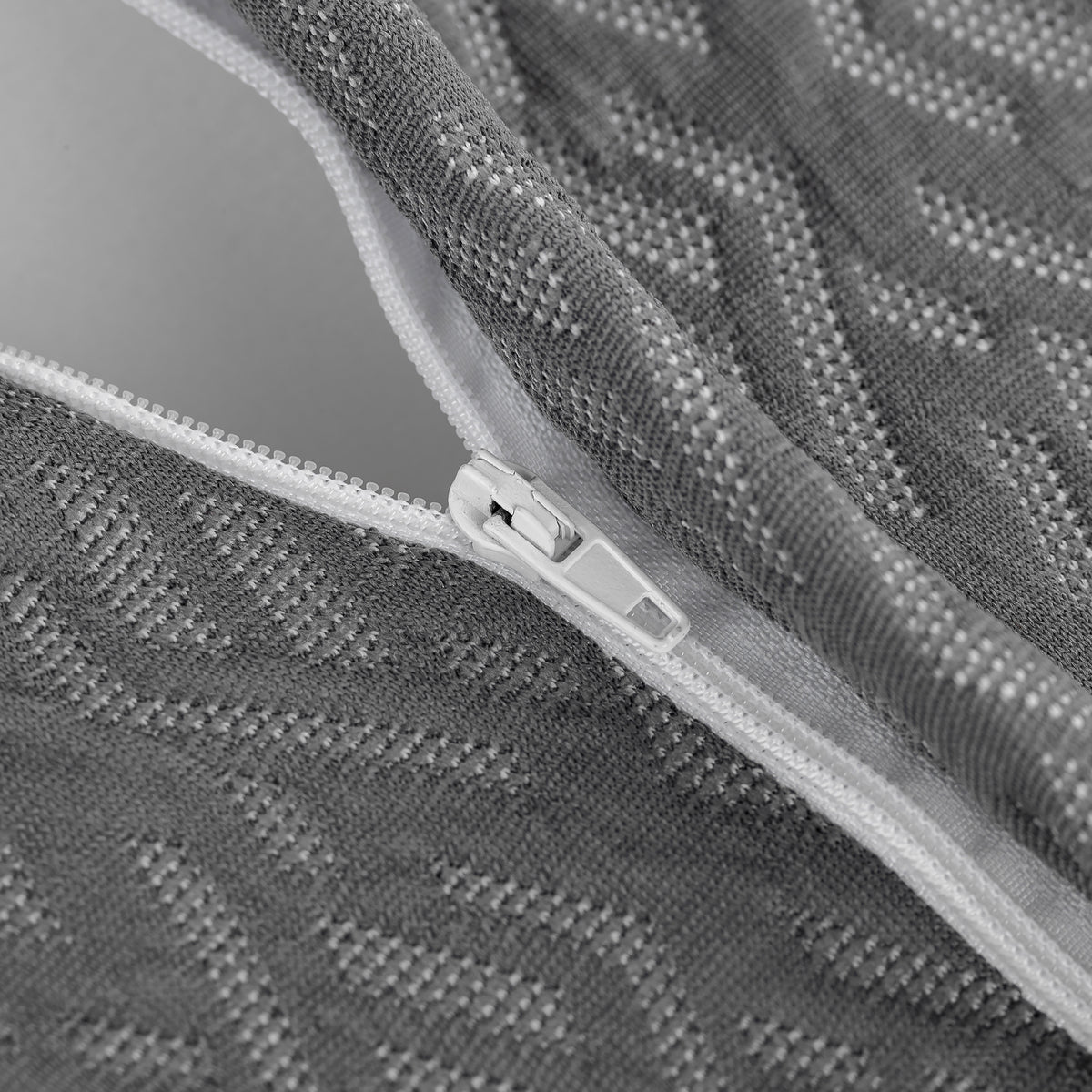
Keep ID and fit checks separate: identifying an official S1 cover zipper photo proves only that the pictured cover shows that zipper detail; proving a particular cover SKU fits needs the SKU’s compatibility list, seam shape, opening orientation, and insert measurements matched to the pillow outline for that listing. Use the photo to identify the closure type, then confirm fit from the SKU’s own specifications rather than from the zipper close-up alone.
Leave a Reply